In Luke chapter 7, a woman with a bad reputation weeps on Jesus' feet, and he says to her: "Thy faith hath saved thee; go in peace."
One chapter later, a woman who has been bleeding for twelve years touches the hem of his coat, and he says to her: "Thy faith hath made thee whole; go in peace."
Two women. Two rescues. Two different English sentences — and in Greek, the very same six words. Not similar. Identical, letter for letter.
Somewhere between the Greek and your Bible, one word became two, and a large idea got cut in half.
The verse.
"And he said unto her, Daughter, be of good comfort: thy faith hath made thee whole; go in peace" (Luke 8:48). The woman has bled for twelve years and, Luke says, "spent all her living upon physicians, neither could be healed of any." She is ceremonially unclean, which means twelve years without a hand on her shoulder. She comes up behind him in a crush of people, touches the border of his garment, and is healed on the spot — and he stops a whole crowd to turn around and call her daughter.
The translations can't agree — and there are four camps.
Line up the ten translations in DeepWord at this one verse and they scatter further than usual:
The King James, the Restored Name KJV and the ASV say his faith line ends "made thee whole." The Berean Standard and Darby say "healed thee." The New Heart, the WEB and the Bible in Basic English say "made you well." And the Lexham and Young's Literal — the two that hug the Greek hardest — say "your faith has saved you."
Whole. Healed. Well. Saved. Four different English words for one Greek verb, and no two committees can decide whether what happened to this woman was a medical event or a spiritual one.
The word Luke actually wrote.
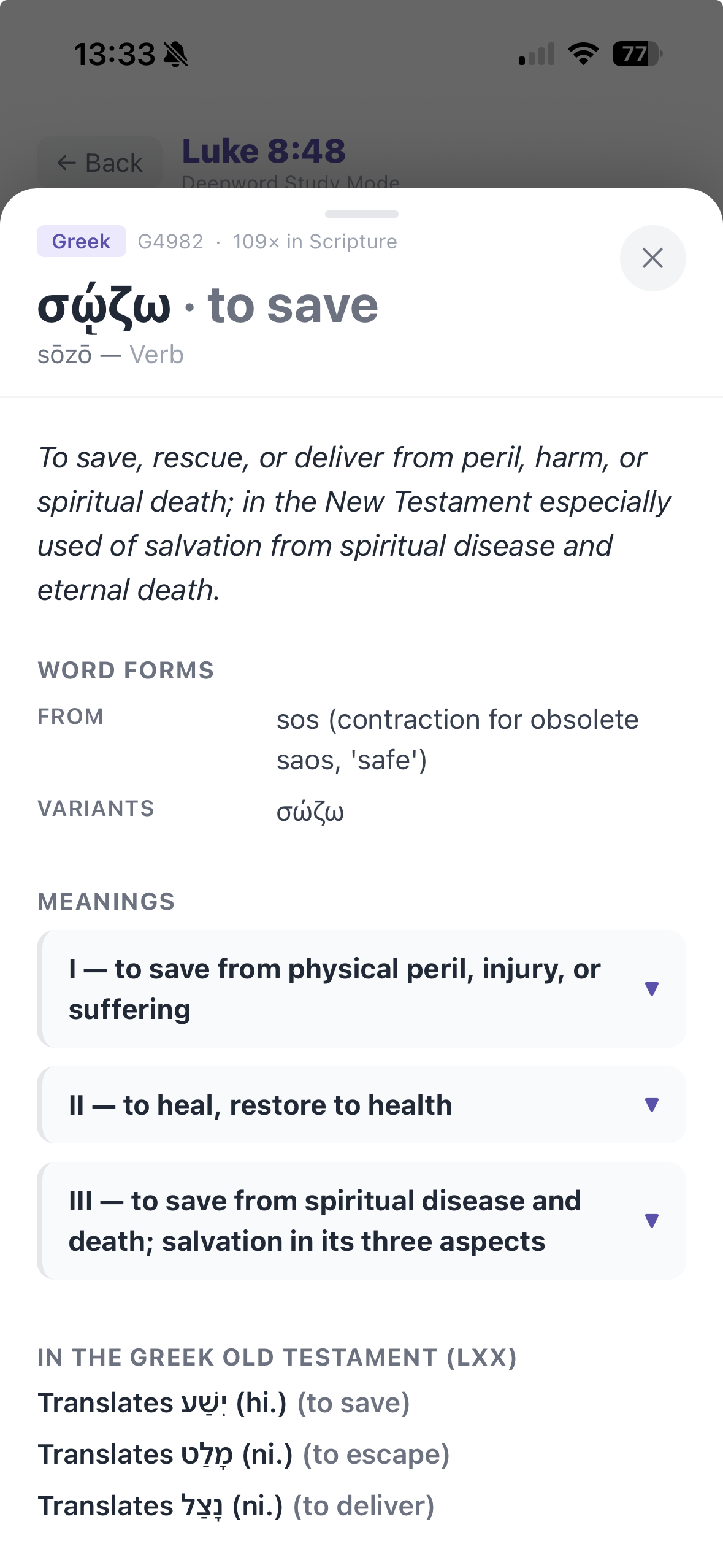
The Greek is σῴζω — sōzō (Strong's G4982), and it appears 109 times in the New Testament. It comes from an old root, sōs, meaning simply safe. The verb means to bring somebody safe out of danger — to get them through it, intact.
You already know its family. Take sōzō and make a person out of it and you get sōtēr — Saviour. Make a thing out of it and you get sōtēria — salvation. This unassuming little verb is the root of the biggest words in the New Testament.
And the exact form Jesus uses here, sesōken, is a perfect tense: an action finished, with a result that is still standing. Not you were rescued once. You have been brought to safety, and safe is what you now are.
Its plain meaning: whatever the danger was, out of it.
English forces a choice that Greek never makes. We have a religious word (saved) and a medical word (healed) and a general word (rescued), and we keep them in separate rooms. Greek keeps one word and lets the situation say what the danger was.
So the King James, working faithfully, has to translate this single verb as save, saved, made whole, be whole, healed and preserve, choosing each time based on what it judged the person was in trouble with. That's not sloppiness. That's an honest translator running out of English.
And notice how wide the danger can be. In Matthew 8:25 the disciples in a sinking boat scream "Lord, save us: we perish" — that's this verb, and they mean don't let us drown. In Acts 27, mid-shipwreck, Paul tells the soldiers that unless the sailors stay aboard, "ye cannot be saved" (v.31). Same word. It means: you will not survive the night.
And the lexicon lays it out plainly.
Open the full entry on sōzō in DeepWord and you can see the range set out in order, rather than buried in abbreviations. Sense one: to save from physical peril, injury or suffering. Sense two: to heal, to restore to health. Sense three: to save from spiritual death — and that third sense is itself broken into the three tenses of salvation the New Testament actually uses: something finished in the past (Ephesians 2:8, Titus 3:5), something happening now (1 Corinthians 1:18, Acts 2:47), and something still coming (Matthew 10:22, Romans 5:9).
One entry, one word, one continuous meaning — with the medical sense sitting in the middle of it, not off in a footnote.
Follow it around and the seams show.
Once you can see the word, the inconsistencies in your English Bible start lighting up — and they run in both directions.
Back to our two women. Luke 7:50, to the woman with the alabaster jar: hē pistis sou sesōken se; poreuou eis eirēnēn. Luke 8:48, to the bleeding woman: hē pistis sou sesōken se; poreuou eis eirēnēn. The same six words in the same order, one chapter apart, in the same Gospel, by the same author. The King James translators gave one woman "hath saved thee" and the other "hath made thee whole" — because they'd decided in advance that one story was about sin and the other was about blood.
Then it flips. In Luke 18:42 a blind man gets his eyesight back, and there the King James writes "thy faith hath saved thee." A plain physical healing, rendered with the religious word. Meanwhile in Luke 8:50, Jairus is told of his twelve-year-old daughter — who at that point is dead — "she shall be made whole." Same verb again. It stretches to cover a corpse.
And then Paul picks it up and puts your whole salvation on it: "For by grace are ye saved through faith" (Ephesians 2:8) is this verb, and it too sits in the perfect tense — the same done-and-still-standing grammar Jesus used on a woman who had just stopped bleeding. If you've read the study on charis, that's the other half of the same sentence.
Nine men got their skin back. One got something else.
The clearest proof that Luke knew exactly what he was doing sits in a story most of us file under "gratitude."
Ten lepers meet Jesus on the road and shout for mercy. He sends them to the priests, and on the way, Luke says, "they were cleansed" (Luke 17:14). The word there is katharizō — to make clean. Jesus uses it himself two verses later: "Were there not ten cleansed?" (v.17). All ten. No exceptions. Ten men walked away with new skin.
One of them turned around. A Samaritan, of all people, came back, fell on his face and thanked him. And to that one man alone Jesus says something he did not say to the other nine: "Arise, go thy way: thy faith hath made thee whole" (v.19).
Different verb. That one is sōzō.
Ten men were cleansed. One was saved. Luke uses two different words eight verses apart, and every English Bible that renders the second one "made thee whole" quietly hides the difference between them.
None of this makes every healing a salvation, or turns faith into a lever that guarantees a cure — the New Testament is full of faithful people who stayed sick. What it does is show you that the Bible's idea of rescue was never confined to the part of you that outlives your body. When Jesus told that woman to go in peace, the word was eirēnē — the Greek that Greek-speaking Jews used for the Hebrew shalom, which doesn't mean calm. It means every piece of you back where it belongs.
He didn't stop her bleeding and then, separately, forgive her. He used one word. She got one thing.