It's the oldest blessing in the Bible, the one priests have spoken over people for three thousand years. "The Lord lift up his countenance upon thee, and give thee peace." We hear that last word and picture calm — quiet, stillness, nothing going wrong for a while.
But the Hebrew word behind "peace" is carrying far more than that. It isn't promising you a break from trouble. It's promising you something whole.
The blessing you've heard a hundred times.
Numbers 6:24–26 is the Aaronic blessing — the words God told Aaron to speak over Israel. It closes like this: "The Lord lift up his countenance upon thee, and give thee peace." You've heard it at the end of services, at weddings, at funerals. Stop today on that final word: peace.
The translators reach past "peace."
Almost every English Bible says "peace" here, because there's no single word that does better. But read the footnotes and study editions and you'll see them straining: "well-being," "wholeness," "prosperity." That straining is the tell. English "peace" mostly means the absence of something — no war, no noise, no conflict. The Hebrew means the presence of something.
The word Aaron actually spoke.
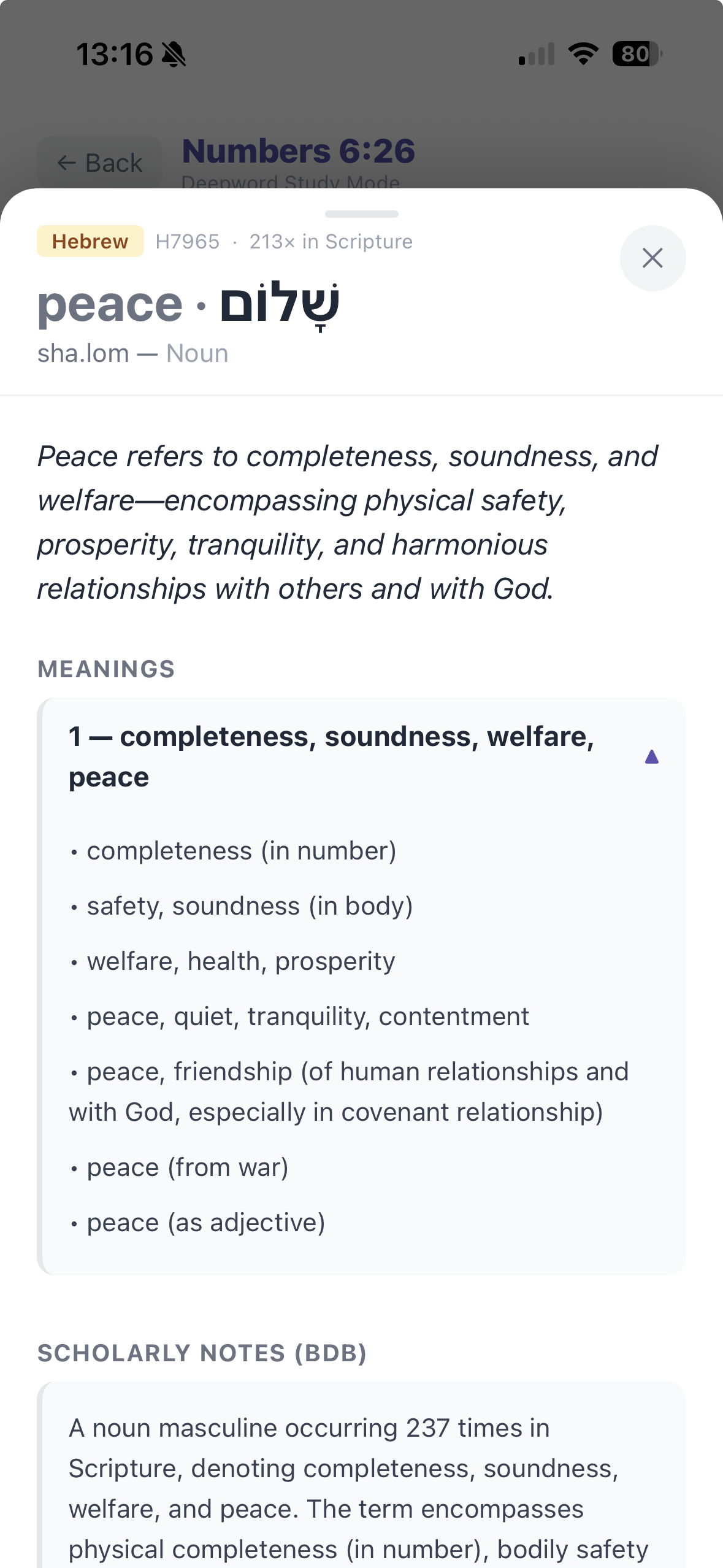
The Hebrew is שָׁלוֹם — shalom (Strong's H7965). You probably know it as a greeting. But shalom isn't a soft word for quiet. It comes from a root, shalem, that means to be complete, whole, sound — with nothing missing and nothing out of place.
Its plain meaning: completeness, wholeness, soundness.
Strip shalom to its core and it means completeness, soundness, welfare, well-being. It's the state of a thing when every part is present and working — a body that's healthy, a relationship that's mended, a life with no gaping holes in it. When Hebrews greeted each other with shalom, they weren't saying "no conflict, I hope." They were asking, are you whole? is everything where it should be?
And the lexicon shows where it comes from.
Here's the part that reframes the whole blessing. Open the full lexicon entry on shalom in DeepWord and follow it back to its root. The same root that gives us shalom also gives the verb for making something whole again — paying a debt in full, restoring what was lost, repaying what was owed until the books are balanced and nothing is outstanding.
So shalom isn't just a calm feeling. It's the language of restoration — debts settled, what was broken set right, what was missing put back. When God says he will give you shalom, the picture isn't God turning the volume down on your problems. It's God making you whole.
See it everywhere else it appears.
Once you know the word, you start catching it everywhere. When Joseph asks his brothers about their father, he asks after his shalom — "is it well with him?" When David is sent to the battlefield, he goes to inquire of the shalom of his brothers — how they're faring, whole and unharmed. The same word covers health, safety, prosperity, and friendship. It even hides inside the name of a city: Jerusalem. Across the Hebrew Bible shalom appears more than 230 times, and it almost never means merely "no fighting."
The blessing Aaron actually spoke.
So the end of the oldest blessing in Scripture isn't a wish for a quiet life. It's bigger and far more daring: may God make every part of your life whole — nothing missing, nothing broken, everything restored to its right place. That's what those priests were placing on people's heads all those centuries. Not a truce. A repair.
You've heard this blessing your whole life. It took one word, in the original, to turn a wish for quiet into a promise of wholeness.