Ephesians 2:8 is the verse people quote to explain the whole gospel in a single breath. "For by grace are ye saved through faith." We say the word grace so often it has gone soft — grace before dinner, a grace period, amazing grace. Somewhere along the way it turned into churchy background music.
I'd read that verse a hundred times without stopping. Then one day I tapped the word grace — and found a word so alive that three other words we use all the time were born out of it.
The verse you think you already know.
"For by grace are ye saved through faith; and that not of yourselves: it is the gift of God." It's the verse underlined in every study Bible, the one printed on the bookmark. Familiar enough to read straight past. Today, stop on the word grace.
The translators quietly disagree.
Line up a few translations and the wording holds fairly steady — "grace" almost everywhere. But the footnotes and older renderings keep circling the same cluster of plainer words: favor, kindness, a gift freely given. That's the tell. When translators reach for "grace," they're reaching for one English word big enough to hold "undeserved favor" — and not quite finding it.
The word Paul actually wrote.
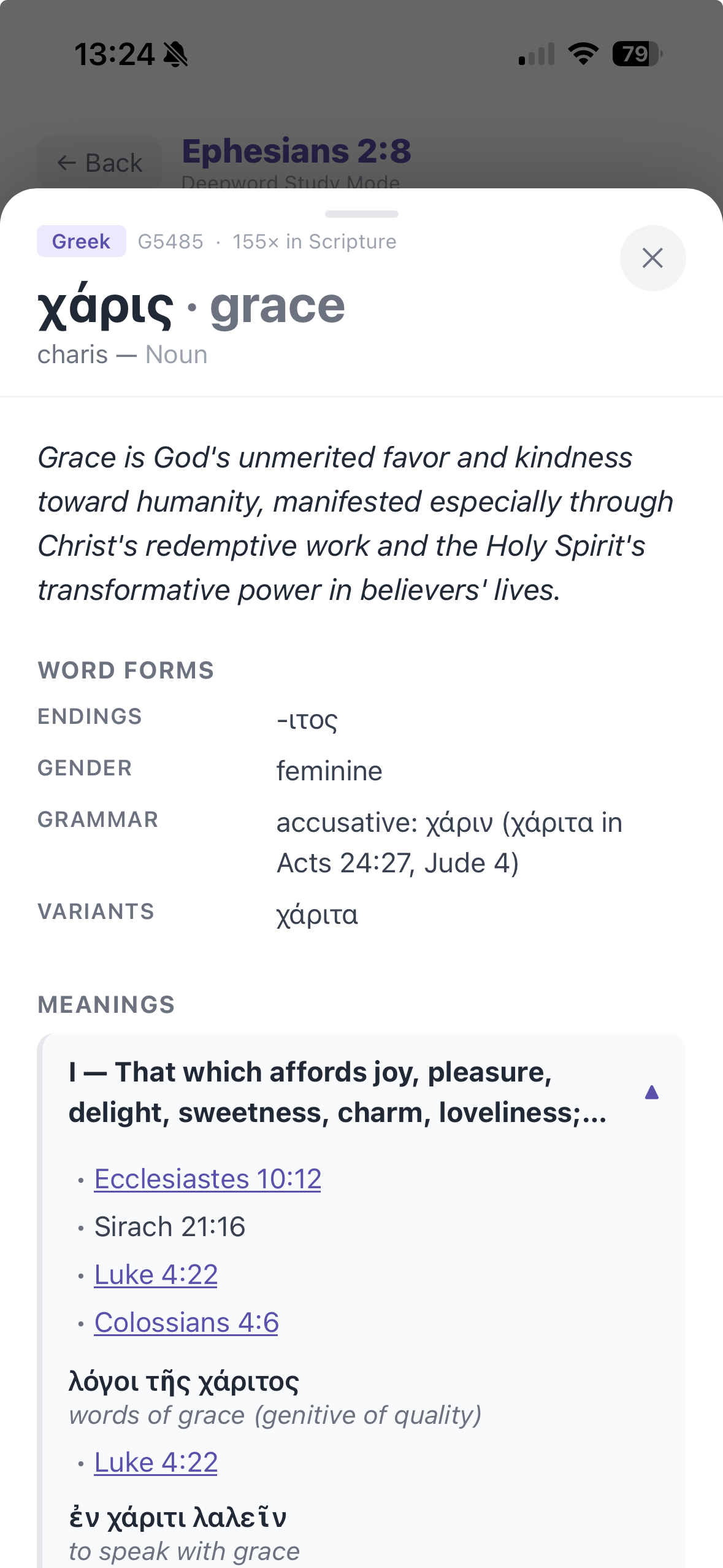
The Greek is χάρις — charis (Strong's G5485). And charis was not a religious word first. In everyday Greek it meant a favor freely given, the graciousness of the one giving it, and the sheer loveliness of a gift — all at once. A charis was something placed in your hands that you had done nothing to earn.
Its plain meaning: a free, unearned gift.
Strip it to the core and charis means favor freely given — a gift, not a wage. It's the opposite of something owed. You can't work for a charis; the moment you earn it, it stops being one. And Paul knew exactly what he was doing: in the very same breath he pairs it with another word — "it is the gift (dōron) of God." He says it twice so you can't miss it. Grace is a present.
And the lexicon confirms the twist.
Here's where it gets beautiful. Open the full lexicon entry on charis in DeepWord and follow the word family. Charis shares its root with chara — joy. It's the parent of charisma — a gift of grace. And it's the heart of eucharistia — thanksgiving, the word we get "Eucharist" from. Grace, joy, gift, and thank-you are all one family.
That's not an accident of spelling. It's the whole shape of the thing: a free gift (charis) lands as joy (chara) and comes back out as gratitude (eucharistia). Grace isn't a flat theological term — it's a circuit: favor pouring out for free, received as gladness, returned as thanks.
See it everywhere else it appears.
Once you see it, charis is everywhere. It's how Paul opens nearly every letter — "grace (charis) to you and peace." It's the "gifts" of the Spirit (charismata). It's John 1:16, "grace upon grace" — charis piled on charis. And every time a believer gives thanks — eucharistia — they are literally speaking grace back to God. One word, threaded through the whole New Testament, quietly tying favor to joy to gratitude.
The picture Paul actually painted.
So Ephesians 2:8 isn't telling you to try harder or clean yourself up first. It's the opposite. Charis means a gift you could never earn and never repay — and Paul doubles down by calling it "the gift of God" in the same sentence. You didn't buy it. You can't. You can only receive it, and let it do what grace always does: turn into joy, and come back out as thanks.
You've said the word grace your whole life. It took the Greek to hear what's actually inside it — a gift so free it grew a whole family of words for joy.