Almost everyone who grew up around church carries the same picture of repentance: a bowed head, a knot in the stomach, a long list of things you feel bad about. Something you have to feel hard enough for it to count.
The Hebrew word underneath it has nothing to do with feeling. It's a word about which way you're walking.
The verse, and the moment it was written into.
Joel is writing to a nation that has just been stripped bare. A locust swarm has eaten the harvest down to the stalk — no grain, no wine, no offering left to bring. And in that ruin the prophet delivers God's line: "Therefore also now, saith the LORD, turn ye even to me with all your heart, and with fasting, and with weeping, and with mourning: And rend your heart, and not your garments, and turn unto the LORD your God" (Joel 2:12-13).
Notice what he's arguing against. Tearing your clothes was the standard public display of grief in the ancient Near East — visible, loud, unmistakable. Joel says: not that. Something else.
Here the translations quietly disagree.
Open Joel 2:13 in ten English Bibles and you get four different verbs for one Hebrew word. The KJV, RNKJV, ASV, Darby, NHEB and WEB all say "turn" unto the Lord. The BSB and LEB say "return." Young's Literal says "turn back." The BBE says "come back."
Now notice the word that isn't there. Not one of them says repent. The single most famous idea in the Hebrew prophets — the thing every sermon calls repentance — is being carried by a verb that just means go back the way you came.
The word Joel actually used.
The Hebrew is שׁוּב — shuv (Strong's H7725), from the root sh-w-b. Its plain, first meaning is to turn back, to return. Stop going that way. Go back toward where you started.
There is no sorrow inside the word. No guilt, no groveling, no emotional threshold you have to clear. Just a reversal of direction — and a destination.
Its plain meaning: this isn't a religious word.
That's the part that surprises people. Shuv isn't specialist temple vocabulary. It's one of the most ordinary verbs in the entire Hebrew Bible — it appears over a thousand times, and most of those have nothing to do with God at all.
It's what Naomi does when she leaves Moab: "she arose... that she might return from the country of Moab" (Ruth 1:6). It's what soldiers do when they break off a pursuit and head back to camp. It's what the shadow does on Ahaz's sundial when it's brought backward ten degrees (2 Kings 20:11). It's even how the story of dust ends: "till thou return unto the ground... unto dust shalt thou return" (Genesis 3:19) — the same verb, twice, in one sentence.
So when a prophet stands up and shouts shuv, the crowd isn't hearing stained-glass language. They're hearing the word they'd use for walking home.
And the lexicon lays the whole shape out.
Open the full entry on shuv in DeepWord and you can watch the meaning fan out from that one physical center: turn back from a march; return home to a person or a place; return to dust; be restored to health; bring something back to its rightful owner. Only then, deep in the same entry, comes the spiritual branch — turn back to God, turn away from evil. The religious sense isn't a separate word. It's the ordinary word, pointed at God.
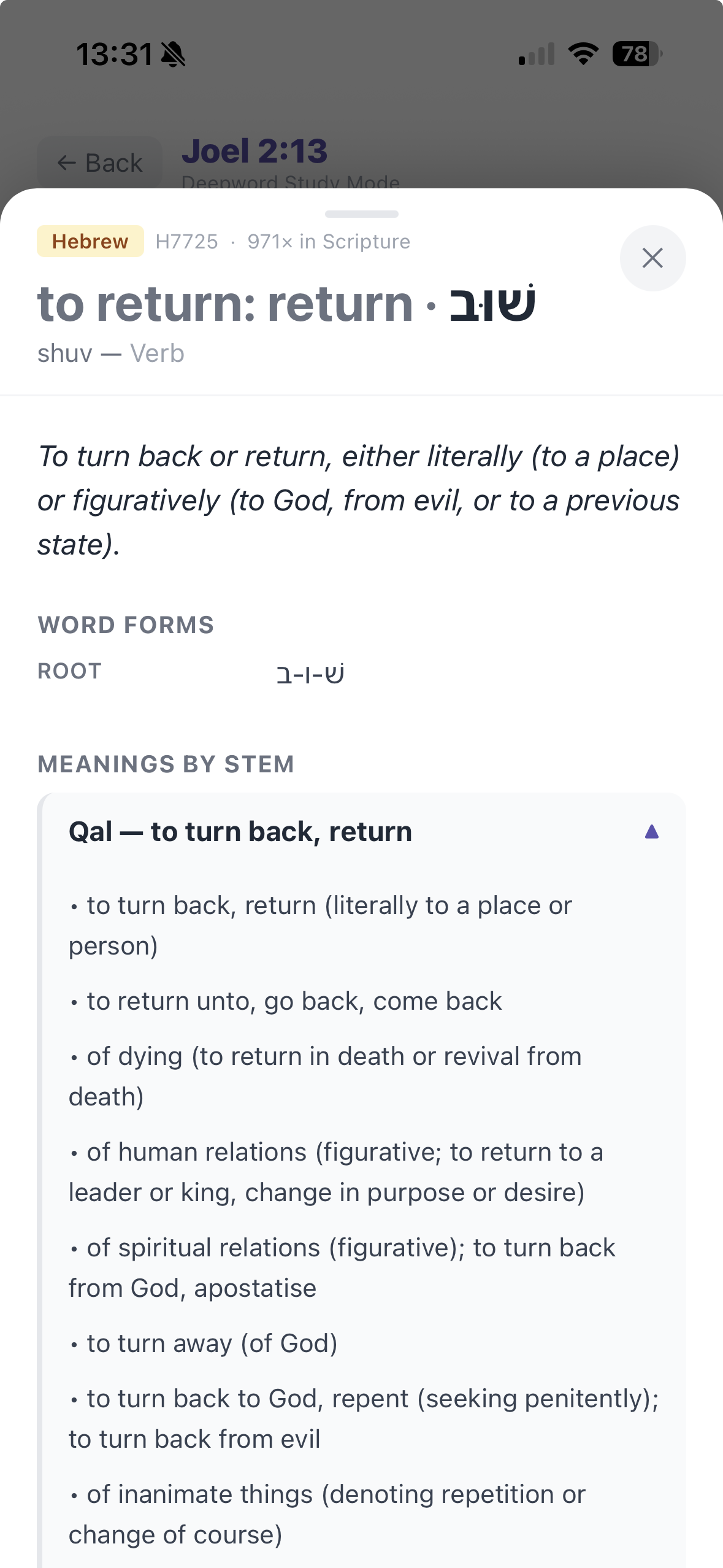
Every place it appears — including the places God says it about himself.
Once you can see shuv, the prophets start rhyming. "Come, and let us return unto the LORD" (Hosea 6:1). "Let him return unto the LORD, and he will have mercy upon him" (Isaiah 55:7). "Turn ye, turn ye from your evil ways; for why will ye die?" (Ezekiel 33:11 — the verb three times in one verse).
And then comes the thing almost no English reader ever sees. In Zechariah 1:3, God says: "Turn ye unto me... and I will turn unto you." Both of those are shuv. Malachi 3:7 does it again — three times in a single verse: "Return unto me, and I will return unto you... But ye said, Wherein shall we return?"
God uses the repentance verb about himself. Whatever motion he's asking you to make, he describes making the same motion toward you. And Joel does it too, one verse after our verse: "Who knoweth if he will return..." (Joel 2:14). You turn. He turns. The word doesn't change.
What English lost on the way here.
Our word "repent" came into English through Old French, from the Latin paenitere — "to cause regret, to be sorry." It's the same family that gives us penitent, penance, and penitentiary. Which explains everything about how the word feels now: English built repentance out of sorrow and punishment. Hebrew built it out of walking.
That difference isn't a technicality. It's the difference between wondering whether you're sorry enough and simply deciding which direction to face. And look at the rest of Joel 2:13, the half of the verse we usually skip: turn to him, "for he is gracious and merciful, slow to anger, and of great kindness" — that last phrase is chesed, the loyal love that refuses to quit. Joel doesn't ask for the turn and then hope God is willing. He names what's waiting at the other end of the road first.
Centuries later the New Testament would reach for a Greek word, metanoia — a changed mind. Hebrew got there first with something simpler and more physical: changed feet. And if you want the tenderest version of the verb, it's sitting in a psalm you already know by heart. "He restoreth my soul" (Psalm 23:3) is shuv as well — he brings my soul back.
You were never asked to feel your way home. You were asked to turn around. Someone is already walking toward you.