Say the word repent out loud and watch what your body does. Shoulders down, head bowed, a wince. It sounds like grovelling — sackcloth and ashes, a man on his knees promising never to do it again. For a lot of people it's the most off-putting word in the whole Bible.
But that flinch comes from the English word, not the one Paul actually wrote. The Greek behind it isn't about beating yourself up at all. It points the other way entirely — up and forward, toward a mind that has been completely changed.
The verse you think you already know.
"Or despisest thou the riches of his goodness and forbearance and longsuffering; not knowing that the goodness of God leadeth thee to repentance?" (Romans 2:4). Read it quickly and "repentance" lands like a demand — shape up, feel bad, make amends. But look at what's actually pulling a person there. Not God's anger. Not a threat. His goodness. Today, stop on that last word — repentance — because it isn't what the flinch says it is.
The translators quietly disagree.
Most English Bibles say "repentance," and have for centuries. But notice a few of the newer ones reaching for something different: "God's kindness is meant to lead you to a change of heart and life." That's not a softer paraphrase — it's an attempt to recover what the old word buried. "Repent" came to English through the Latin paenitentia, "penance" — the language of regret and self-punishment. The Greek underneath was never that word.
The word Paul actually used.
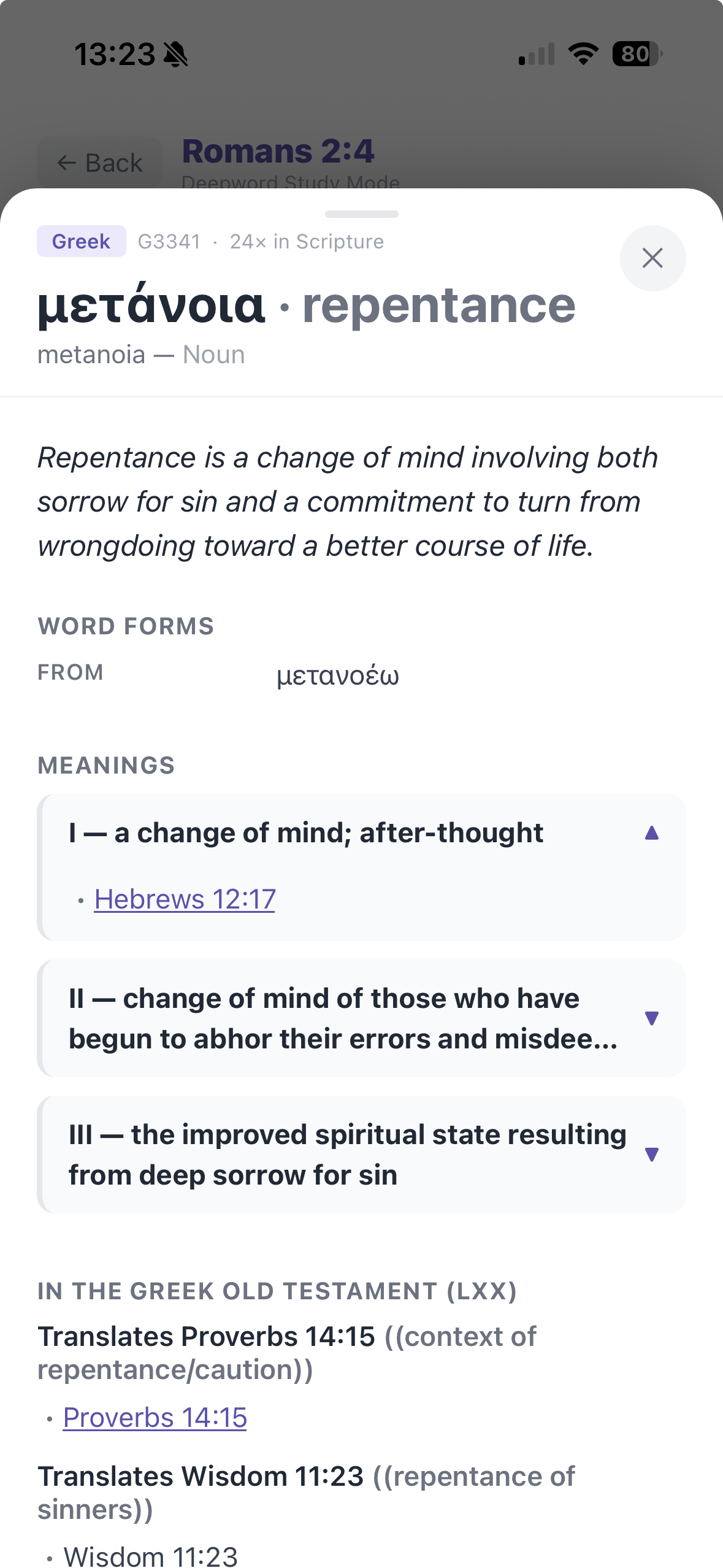
The Greek is μετάνοια — metanoia (Strong's G3341). It's built from two pieces: meta, meaning change or after, and nous, the mind. Put them together and the literal sense is plain: a change of mind — an after-thought, a rethinking. Not an emotion you work up. A new way of seeing that you walk out of.
Its plain meaning: a new mind, not a beating.
The lexicons are unanimous on the root: metanoia is "a change of mind" — and from there, the whole-person turn that follows when someone begins to see their life differently. It includes honest sorrow over what's wrong, yes. But the engine of the word isn't the sorrow; it's the turn — the moment the lights come on and you think, I've had this backwards. One early writer, dissatisfied with the Latin "penance," argued it should really be rendered resipiscentia — literally coming back to your senses.
And the lexicon confirms the turn.
Open the full entry on metanoia in DeepWord and the shape of the word comes clear. The root is a verb of perceiving — nous, the mind — so the noun is fundamentally about changed thinking that changes direction, not about feeling miserable. And then look back at the verse it sits in. Romans 2:4 says it is God's kindness — not his disappointment, not his fury — that leads you there. The word for "leads" is gentle: to bring along, to draw. Kindness is the hand on your shoulder turning you around.
That's the reversal hiding inside a word people brace against. Metanoia isn't God shaming you into line. It's God being so good to you that, somewhere in your mind, everything quietly reorganizes — and you turn toward home.
See it everywhere else it appears.
Once you hear "change of mind," the word opens up across the New Testament — twenty-two times in all. John the Baptist demands fruit that proves it (Matthew 3:8). Heaven throws a party over one person who turns (Luke 15:7). Paul tells the Corinthians that godly sorrow produces this change "and leaves no regret" (2 Corinthians 7:10) — the opposite of the misery we picture. And when the early church watched outsiders come in, they marveled, "God has granted even the Gentiles repentance unto life" (Acts 11:18). A change of mind, given as a gift.
The word behind the wince.
So Romans 2:4 isn't a finger in your face. It's an invitation built on kindness: God is good to you on purpose, hoping the goodness will change how you see — and that the new mind will carry your feet in a new direction. (If you've read our study of chesed in Lamentations 3:22, the loyal love that never quits, metanoia is what that love is gently leading you toward.)
You've heard "repent" your whole life as a word that pushes you down. It took one Greek word to show it's actually a word that turns you around — and that the hand doing the turning is kind.