"It is of the Lord's mercies that we are not consumed, because his compassions fail not. They are new every morning: great is thy faithfulness." Lamentations 3:22–23 — the verse behind the hymn, the one cross-stitched on kitchen walls. In English it reads warm and a little soft. The word that carries the whole thing is mercies.
But pull up four translations and you'll notice something odd: almost no two of them render that word the same way. That disagreement isn't sloppiness. It's a clue that English doesn't have the word the poet used.
The verse you think you already know.
It's the comfort verse — the one people reach for on the hardest mornings. "Great is thy faithfulness" became a hymn millions can sing from memory. We read right past the line before it: that the reason we are "not consumed" is the Lord's mercies. Today, stop on that word.
The translators quietly disagree.
Set the versions side by side and watch them scatter. The KJV says "mercies." The ESV says "steadfast love." The NASB says "lovingkindnesses." The NIV says "great love." Others reach for "unfailing love" or "true love." When every translator picks a different English word for the same Hebrew word, it usually means one English word doesn't exist.
The word the poet actually wrote.
The Hebrew is חֶסֶד — chesed (Strong's H2617). It's one of the most important words in the entire Hebrew Bible, and one of the most famously untranslatable. Centuries ago, when English Bibles needed a word for it and none fit, translators stitched two together and invented one: lovingkindness.
Its plain meaning: loyal love that refuses to quit.
At its core, chesed is kindness you can count on — loyal, covenant-keeping love. Not affection that comes and goes with the mood, but love bound by commitment: the steady goodness one person owes another inside a relationship, especially toward someone weak, low, or in need. It's love as a promise, not love as a feeling. That's why "mercy," "kindness," and "faithfulness" all crowd into the same word — and why no single English term can hold them at once.
And the lexicon confirms the depth.
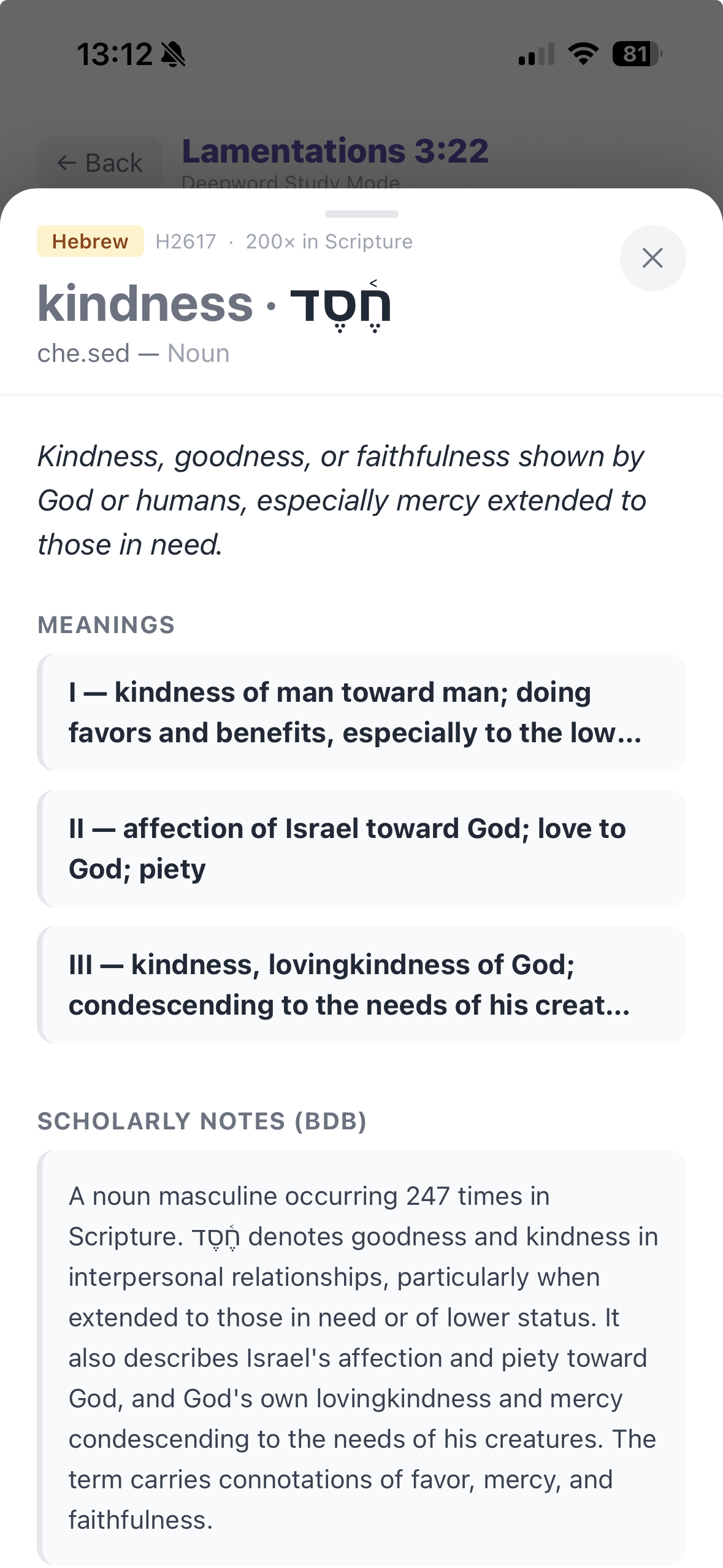
Open the full lexicon entry on chesed in DeepWord and the richness is laid out in plain sections. The standard Hebrew lexicon (Brown-Driver-Briggs) lists three senses of the same word: kindness shown between people, especially "to those in need or of lower status"; Israel's devotion and piety toward God; and God's own lovingkindness, "condescending to the needs of his creatures." One thread runs through all three — faithful kindness inside a relationship. The entry sums it up as favor, mercy, and faithfulness, all together.
That's the reversal hiding in Lamentations. The book is a funeral poem over a city in ashes. And the poet's reason for hope isn't that the pain is small — it's that God's chesed, his loyal covenant love, has not quit. The rubble is real. So is the love that refuses to walk away from it.
See it everywhere else it appears.
Once you know chesed, you find it holding up the whole Old Testament. It appears around 250 times. It's the refrain of Psalm 136, where "his chesed endures forever" repeats twenty-six times in a row. It's at the center of God's self-description to Moses in Exodus 34:6 — "abounding in chesed and faithfulness." It is the covenant word, the one Israel leaned on every time it had nothing left to lean on.
The picture the poet actually painted.
So Lamentations 3:22 isn't a soft sentiment on a greeting card. It's a man sitting in the wreckage of everything he loved, saying the only reason any of us are still standing is a love that keeps its promises when we can't keep ours — and that shows up "new every morning." (If you've read our study of radaph in Psalm 23:6, this is the very love that does the chasing — the goodness that hunts you down is chesed.)
You've sung this verse your whole life. It took one untranslatable word to show that the comfort in it is far tougher, and far more loyal, than the English ever let on.