Here are two verses from opposite ends of the Old Testament, in the King James Version.
Psalm 103:13, about a father: "Like as a father pitieth his children, so the LORD pitieth them that fear him."
Isaiah 49:15, about a mother: "Can a woman forget her sucking child, that she should not have compassion on the son of her womb?"
A father who pities. A mother who has compassion. In English those are two different sentiments in two different registers. In Hebrew they are the same verb — and the verb has a history the father's sentence gives no hint of.
The gentlest thing anyone ever said about God.
Psalm 103 is the psalm people reach for when they need to be told God is not angry with them. Bless the LORD, O my soul. He forgives all your iniquities. He heals all your diseases. He has not dealt with us after our sins. As far as the east is from the west, so far has he removed our transgressions from us.
And then, in verse 13, David reaches for a comparison — the one image he thinks will land.
Psalm 103:13, King James Version:
"Like as a father pitieth his children, so the LORD pitieth them that fear him."
It is meant to be the warmest line in the psalm. In modern English it is very nearly the coldest, because of what has happened to one word.
Ask yourself honestly how it feels to be pitied. Somebody looks at your situation, decides it is bad, and feels something on your behalf — from where they are standing, which is somewhere better than where you are. Pity is a downward emotion. It is what you feel about a stranger's misfortune on the news. Nobody has ever wanted to be pitied by someone who loves them.
"Pity" was a warmer word in 1611 than it is now, and the translators were not being cold. But four hundred years of drift have left a sentence that was built to comfort you doing something closer to the opposite.
Six say "pity." One says "mercy." Three say "compassion."
Line up the ten translations in DeepWord at this verse and they split three ways.
Six say pity. The King James and the Restored Name KJV: "a father pitieth his children." The ASV the same. Darby: "As a father pitieth [his] children." The Bible in Basic English: "As a father has pity on his children." And the Lexham: "As a father pities his children, so Yahweh pities those who fear him."
One says mercy. Young's Literal Translation: "As a father hath mercy on sons, Jehovah hath mercy on those fearing Him."
Three say compassion. The Berean Standard: "As a father has compassion on his children." The WEB and the New Heart English Bible, near-identically: "Like a father has compassion on his children."
Stop on that spread for a second, because those are not stylistic variations. Pity is a downward feeling. Mercy is a legal one — what a judge or a king grants instead of the punishment he could impose. Compassion is a fellow-feeling, alongside rather than above. Three different postures, from one Hebrew word, and whichever Bible you happen to own has quietly chosen one of them for you.
None of the three is wrong. All three are aiming at something English does not have a single word for.
The word David actually used — twice.
The Hebrew is רָחַם — racham (Strong's H7355), a verb that appears 47 times in the Old Testament.
And here is the first thing the English hides. It is in this one verse twice, in two different forms, and the repetition is the whole architecture of the sentence.
The first is כְּרַחֵם — ke-rachem, the little word "as" fused onto the front of the verb. Word for word: as the having-compassion of a father toward children. The second is רִחַם — richam, a completed act: he has had compassion.
Both sit in the stem Hebrew grammarians call the Piel, which intensifies. This is not a verb idling. And notice what the two halves of the verse actually do: the first is a picture everybody already knows, and the second says that, but it is God, and it has already happened. Not God is the sort of being who might. He has.
Where the word comes from.
Now the part that changes the verse.
Strip racham to its three consonants and you get ר־ח־מ, r-ch-m. Those same three letters spell another Hebrew word — an ordinary, physical, unspiritual one.
רֶחֶם — rechem (H7358). It means womb. It appears 26 times, and it means exactly what it says: the womb, the body part, no metaphor involved.
Brown-Driver-Briggs — the standard Hebrew lexicon, over a century old and still the one scholars reach for — opens its entry on our verb with a single technical abbreviation: verb denominative. That means a verb built out of a noun. English does this constantly: we shelve a book because there are shelves, we mother a child because there are mothers. BDB is saying that racham, the verb for compassion, was formed from rechem, the noun for womb.
To be straight with you, the lexicons disagree about which way round it went. Strong's runs it the other direction — the verb first, the womb named after it. That argument is not settled and this article is not going to settle it. But nobody disputes the part that matters: the compassion word and the womb word are one word family, sharing every consonant they have.
Which is why the plural of the womb noun is not a word about anatomy at all. רַחֲמִים — rachamim (H7356), 45 times in the Old Testament — is the ordinary Hebrew for tender mercies. Literally, wombs. That is what your Bible is saying when it says God's mercies.
And the lexicon says it plainly.
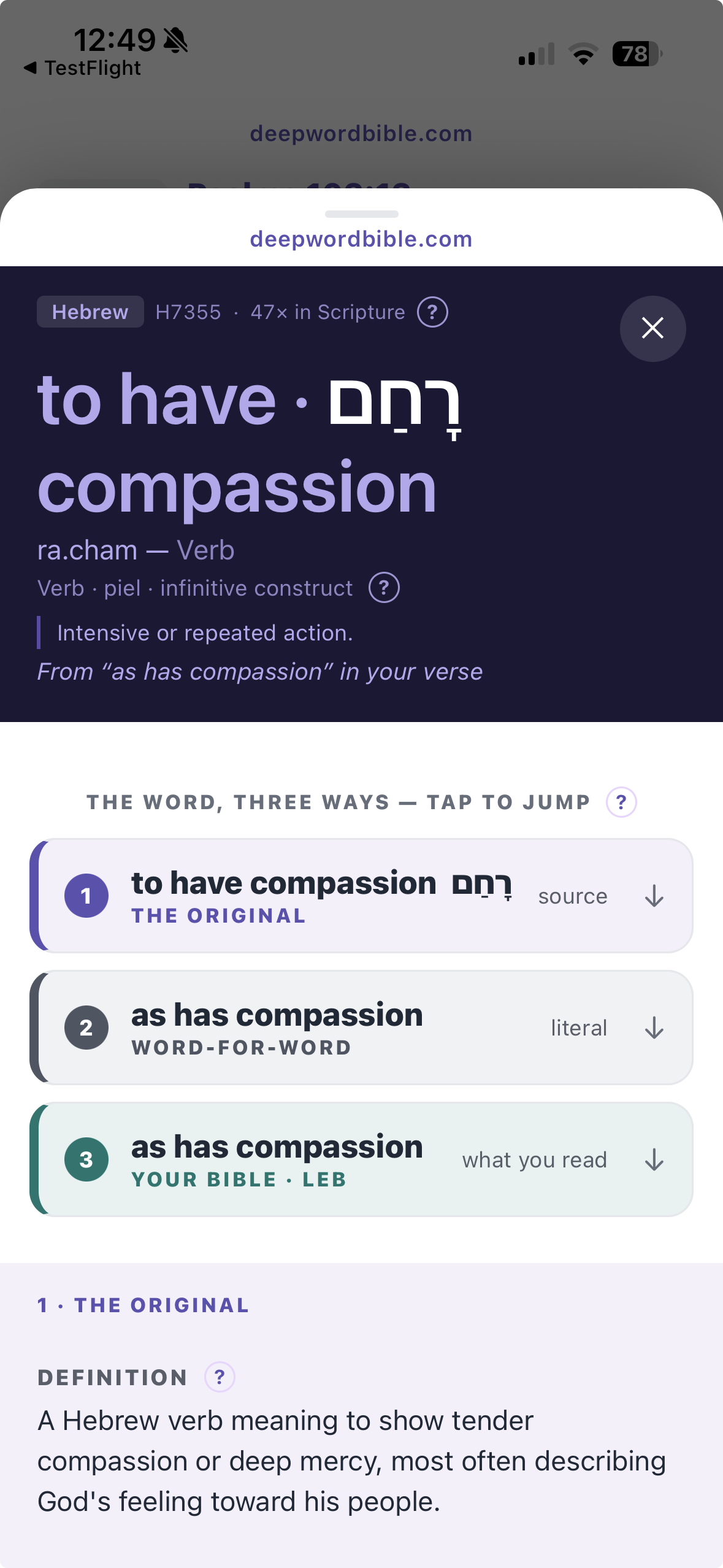
Open racham in DeepWord at Psalm 103:13 and the definition is one sentence, in plain English: "a Hebrew verb meaning to show tender compassion or deep mercy, most often describing God's feeling toward his people."
Above it sits the parsing of the exact form in David's line — verb, Piel, infinitive construct, with a note that the Piel is for intensive or repeated action — and above that, the word laid out three ways: the original, the word-for-word, and what your own translation printed. That last row is the one worth watching. It is where you find out that the English in front of you was a decision somebody made.
Scroll past the definition and the entry keeps going: the etymology line, which is where the womb connection is spelled out; the senses sorted by stem; and the note on what the older scholarship concluded and where it hedged. All of it in sentences you can read without a grammar textbook open beside you.
Follow the word around and it keeps pointing at bodies.
You do not have to leave Psalm 103 to see the family at work.
Nine verses earlier, in verse 4, God "crowneth thee with lovingkindness and tender mercies." That second word is rachamim — the plural of the womb noun. Four verses later, in verse 8, "the LORD is merciful and gracious" uses rachum, the adjective from the same root. By the time David gets to his father-and-children line in verse 13, he has said the same thing three times in three parts of speech.
Then there is what the word does to the prophets.
In Isaiah 49:15, God argues with a people convinced he has forgotten them, and the argument is built entirely out of this verb: "Can a woman forget her sucking child, that she should not have compassion on the son of her womb?" A nursing mother, and the child she carried. Then the twist — yea, they may forget, yet will I not forget thee. He picks the strongest instinct he can name and then says his own runs stronger.
In Lamentations 3:22 — the verse behind an earlier study on chesed — the second half of the line is this word. "His compassions fail not." Rachamim. The first half of that same line is chesed, God's covenant loyalty. Ten verses later, in 3:32, the two words are back, and this time it is the verb that carries ours: "though he cause grief, yet will he have compassion according to the multitude of his mercies" — racham, measured out by the abundance of chesed. The loyalty is the quantity. The womb-word is the feeling.
In Hosea it becomes a child's name. God tells the prophet to call his newborn daughter Lo-ruhamah — "not-compassioned," our verb turned passive and negated, a little girl walking around as a sentence. And then, in Hosea 2:23, the name is reversed: "I will have mercy upon her that had not obtained mercy." Both halves of that line are racham — the promise and the name it cancels, built from one word. The undoing is done with the very word that did it.
And in Exodus 33:19 — the same conversation on the mountain we looked at in the study on kavod — God defines himself with it: "I will be gracious to whom I will be gracious, and will shew mercy on whom I will shew mercy." Twice, like Psalm 103:13. When God is asked what he is like, this is one of the two words he uses.
There is a darker set of occurrences too, and leaving them out would make the word look softer than it is. When the subject is a human being rather than God, Brown-Driver-Briggs sorts the uses into two groups: usually a conqueror — a man standing over a defeated city, deciding whether to spare it — and, elsewhere, a parent toward a child. Jeremiah 6:23: an army that is "cruel, and have no mercy." Isaiah 13:18: soldiers who "shall have no pity on the fruit of the womb." That is the word's other home.
Which is worth sitting with, because Psalm 103:13 belongs to the second group and is standing next to the first. The same verb covers a mother with a newborn and a soldier at a gate. Compassion in Hebrew is not a mood you happen to be in. It is what someone with power does, or does not do, with it — and the psalm is telling you which way the one with all of it has gone.
He is not sorry for you.
Put the pieces back together and read verse 13 again.
David wants to say something about how God feels toward people who are afraid of him and aware of their own failures — which is the whole subject of this psalm. He could have reached for a legal word: God acquits you. He could have reached for a royal word: God is lenient. Hebrew had both.
He reaches instead for a word made out of the body of a mother, and puts a father in front of it.
That combination is not an accident, and it is not a small thing. The sentence names a father, because that was the authority figure in the room — the one whose approval a child in that world lived or died by. And then it describes what he feels with a word built out of the one relationship nobody thinks of as conditional. The verse smuggles a mother's insides into a father's sentence.
So the thing being claimed is not that God feels sorry for you. Sorry-for is pity, and pity keeps its distance; you can pity someone and never touch them. What this verb says is that God's response to you comes from the place a mother's response to her own child comes from — involuntary, physical, and not up for reconsideration.
Now, the caution, because this is where a good insight turns into a bad one. Racham does not mean "womb," and you should be suspicious of anyone who tells you it does. It means to have compassion. The womb is where the word came from, not what it says — the way "heartfelt" is not a claim about your cardiovascular system. The root is the origin of the feeling, not a translation of it. That is exactly why "pity," "mercy" and "compassion" are all defensible renderings and none of them is complete.
And the word does stretch. Once in the whole Old Testament it turns up in a plainer form and means simply love — Psalm 18:1, the opening line of David's victory song: "I will love thee, O LORD, my strength." One man, one occurrence, saying it straight. (Scholars argue about that one, since the near-identical song in 2 Samuel 22 does not have it; the app's own entry tells you so.) Everywhere else it is the compassion word.
But origins leave marks. There is a reason Hebrew built its word for mercy out of the body rather than out of the courtroom, and David gives it to you in the very next line:
"For he knoweth our frame; he remembereth that we are dust."
He is not looking down at you from a better position and finding your situation regrettable.
He is feeling it where a mother feels it.