Here are two sentences from the same chapter of 1 Samuel, three verses apart, in the King James Version.
Verse 18, about old Eli the priest falling backwards off his seat: "for he was an old man, and heavy."
Verse 21, about his daughter-in-law naming her baby as she dies: "The glory is departed from Israel."
One is a remark about a fat old man's body. The other is one of the saddest sentences in the Old Testament. In Hebrew they are built on the same three letters.
The boldest request anyone ever made.
Exodus 33 is the conversation after the golden calf. Moses is negotiating for a nation that has just disgraced itself, and somewhere in the middle of it he stops negotiating and asks for something else entirely.
Exodus 33:18, King James Version:
"And he said, I beseech thee, shew me thy glory."
It is a startling thing to say out loud. Not help us, not forgive them — let me see it. And the answer he gets back is a careful, sideways one: God will make his goodness pass by and proclaim his name (v19), but "thou canst not see my face: for there shall no man see me, and live" (v20).
Which raises a question most of us slide past. What exactly did Moses think he was asking to see?
Nine translations say "glory." One says "honour."
Line up the ten translations in DeepWord at this verse and nine of them agree almost word for word.
The King James and the Restored Name KJV: "shew me thy glory." The ASV: "Show me, I pray thee, thy glory." The New Heart, the WEB and the Lexham all have Moses say "Please show me your glory," and the Berean Standard the same with a capital on the pronoun. Darby: "Let me, I pray thee, see thy glory." The Bible in Basic English: "O Lord, let me see your glory."
Then Young's Literal Translation, which almost always tells you when something is going on underneath:
"Shew me, I pray Thee, Thine honour."
Stop on that, because in English those are two different subjects. Glory is a word about light — radiance, brightness, splendour, the shine coming off something. Honour is a word about standing — respect, rank, the regard other people hold you in. If somebody asked you to sort a hundred words into two piles, you would not put those two in the same pile.
Hebrew puts them in the same pile. It is one noun. And the reason it can be both is that neither of them is what the word is actually about.
The word Moses actually used.
The Hebrew is כָּבוֹד — kavod (Strong's H3519), a noun that appears 200 times in the Old Testament, in 189 different verses, spread across 27 of its books. It is thickest in Psalms (51 times) and Isaiah (38).
Its root is three letters: כ־ב־ד, k-v-d.
And those same three letters give the Old Testament two other everyday words. There is the adjective kaved (H3515), which means simply heavy. And there is the verb kavad (H3513), which the King James mostly translates as to honour — but whose plainer sense is to be heavy, or to make heavy.
So "glory," "heavy" and "honour" all grow from one root. That is not a coincidence to be noted and moved past. It is the definition.
Its plain meaning: what a thing weighs.
Strong's own entry gets to it in two words. Kavod, it says, is "from kavad; properly, weight, but only figuratively in a good sense, splendor or copiousness."
Properly, weight. Everything else in that sentence is what the weight is being used to describe.
Here is the difference, as plainly as it can be put.
Our English word glory asks about light. It is a word for how much shine is coming off a thing — how bright, how dazzling, how impressive to look at. Everything English has hung on it points the same way: glowing, radiant, resplendent, brilliant.
Kavod asks a completely different question. It asks what a thing weighs.
Not how it looks. What it would do to a set of scales. Whether it is substantial or hollow, whether it has mass or is merely shiny. A person with kavod is a person of consequence — someone whose presence in a room changes the room, whose opinion lands with a thud, who cannot simply be waved off. And a person without it is light: insubstantial, easily dismissed, a person you can move.
Which is why one word can be both radiance and respect. Honour is just weight assigned to a person. Splendour is just weight made visible.
And the lexicon lays it out plainly.
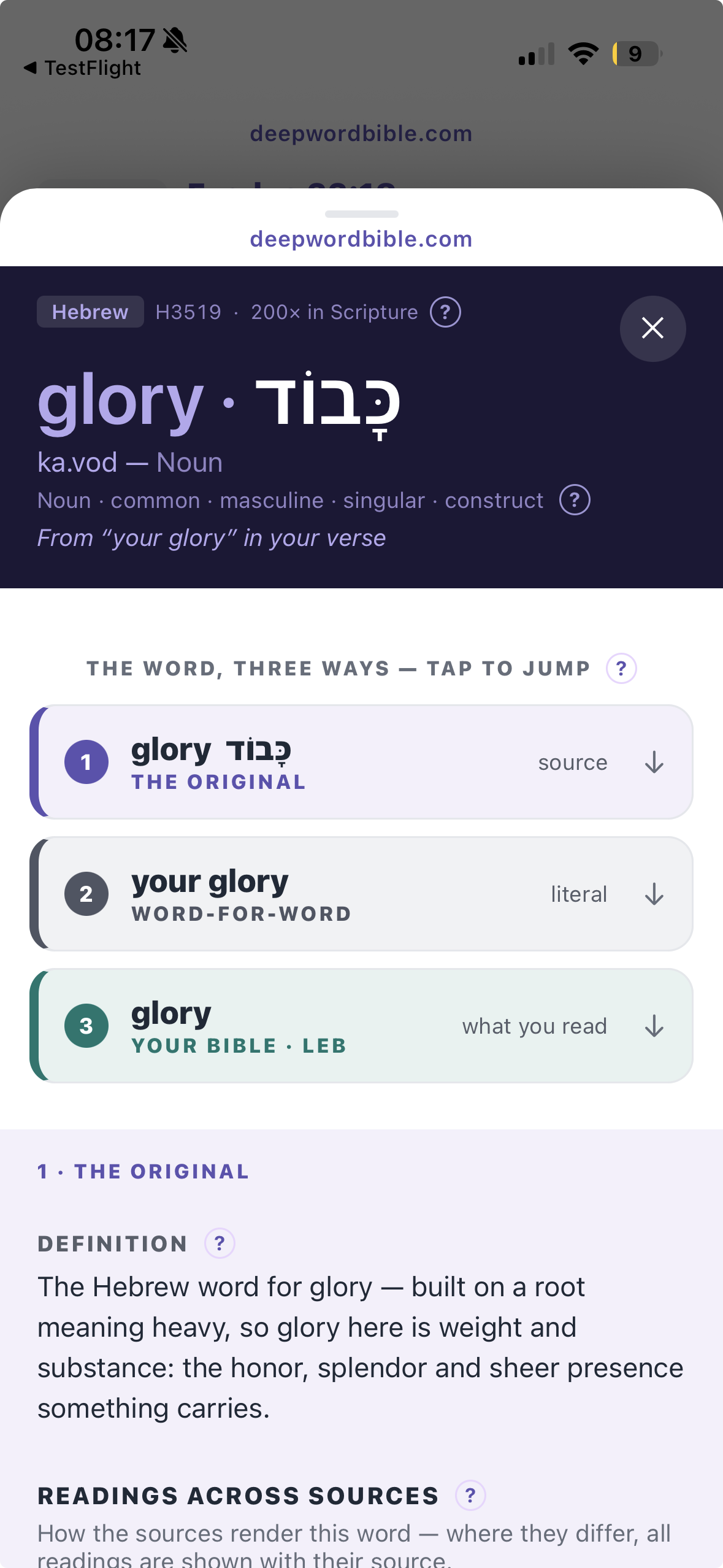
Open kavod in DeepWord and the definition says it without making you dig: "the Hebrew word for glory — built on a root meaning heavy, so glory here is weight and substance: the honor, splendor and sheer presence something carries."
Above it sits the parsing of the actual form in Moses' sentence — noun, masculine, singular, construct — and above that, the word laid out three ways: the original, the word-for-word, and what your own translation printed. That last row is the one worth watching. It is where you find out that the English in front of you was a decision.
And the older lexicons, when you follow the word out of this verse, keep sorting its senses into shades of the same thing: abundance and riches; honour, splendour, glory; dignity; reputation; reverence. Six shades in the standard list, and every one of them is a way of being heavy.
Follow the root around and it is heavy everywhere.
Two hundred occurrences of the noun, and the King James renders it as glory, honour, glorious and honourable. Modern versions reach further and pull out splendor, wealth, riches, abundance and pomp — which should already tell you the word is not primarily about brightness. Nobody translates a light word as "wealth."
But the proof is in the sister words, where the same three letters stay stubbornly literal.
In Genesis 13:2, "Abram was very rich in cattle, in silver, and in gold." The word is kaved. Abram was very heavy — in livestock, silver and gold. English still does this, quietly: we call money weighty, we say someone carries weight, we throw our weight around. Hebrew just never stopped.
In Exodus 4:10, Moses tries to get out of the job: "I am slow of speech, and of a slow tongue." Both of those are kaved. Word for word, he says he is heavy of mouth and heavy of tongue — a man whose words will not lift.
In Exodus 8:15, Pharaoh "hardened his heart." That is the verb kavad: he made his heart heavy. Not stubborn as a mood — stubborn as a mass, an object too heavy to shift.
In Psalm 38:4, "as an heavy burden they are too heavy for me" — the adjective and then the verb, back to back in one line.
And then the commandment. Exodus 20:12: "Honour thy father and thy mother." That is kavad, in the imperative. What it says, underneath the English, is: give them weight. Treat them as substantial. Do not let them be light to you.
There is one more, and it is the one I keep coming back to. Exodus 17:12, during the battle with Amalek: "But Moses' hands were heavy" — kaved — and Aaron and Hur held them up, "and his hands were steady until the going down of the sun." That second word is emunah, the subject of an earlier study. One verse, two of the Old Testament's great words, and between them the whole picture: hands too heavy to hold up, held up anyway.
Glory does not dazzle people. It flattens them.
Once you know the word is about weight, the glory passages stop reading like descriptions of a light show and start reading like descriptions of a load.
Look at what glory actually does to people in the Old Testament.
Exodus 40:35, the day the tabernacle is finished: "Moses was not able to enter into the tent of the congregation, because the cloud abode thereon, and the glory of the LORD filled the tabernacle." Not blinded. Unable to get in — the space was occupied by something with mass.
1 Kings 8:11, the day the temple is dedicated: "the priests could not stand to minister because of the cloud: for the glory of the LORD had filled the house of the LORD." Trained men, on the biggest day of their working lives, who could not stay on their feet.
Notice the verbs the Bible reaches for. Glory fills a room. It settles on a mountain (Exodus 24:16). It takes up space, and it stops people staying on their feet. Those are all things weight does. None of them is a thing light does.
And notice, back in Exodus 33, what God warns Moses about. Not you will be blinded. "Thou canst not see my face: for there shall no man see me, and live." Moses asked to stand in front of the full weight of God, and the answer was that no one is built to take it.
Now — a caution, because this is the point where a good insight can turn into a bad one. None of this means kavod stops meaning splendour, or that "glory" is a mistranslation. Strong's is careful about exactly this: weight is the proper sense, used "only figuratively in a good sense." The translators were not wrong; the brightness is really there, all through the prophets. Weight is not a replacement meaning. It is the thing underneath the brightness — the reason the brightness matters.
And the New Testament writer who knew this best put both halves in one phrase. 2 Corinthians 4:17: "For our light affliction, which is but for a moment, worketh for us a far more exceeding and eternal weight of glory."
Read it as a Hebrew would. Paul has put two things on a balance. On one side, everything that is happening to you — and the word he chooses is elaphron, the Greek for light. On the other side, baros doxēs: a weight of glory. It is not a decorative phrase. It is a man who thought in Hebrew reaching into Greek for the word his own language kept inside kavod all along, so that the scales would be visible to Greek readers too.
Isaiah 43:7 says God created us "for my glory" — for my kavod. Not to add to his shine. To be given weight by the only one who has any to spare.
Moses asked to see the weight of God. He was told to expect it to pass by, and to watch from inside a cleft in a rock, with a hand over his face. Not because it would be too bright.
Because it would be too much.