Search the King James Old Testament for the word faith — thirty-nine books, more than twenty-three thousand verses — and you will find it exactly twice.
One of those two is Deuteronomy 32:20, and it's a different Hebrew word. Which leaves one. One verse, in a short book most people have never read aloud, is the only place the Old Testament's own word for steadfastness came into English as faith.
It is also the verse the New Testament quotes three separate times, and the verse the Reformation was argued on.
The verse.
"Behold, his soul which is lifted up is not upright in him: but the just shall live by his faith" (Habakkuk 2:4).
Habakkuk is a prophet with a complaint. He has been watching violence go unanswered and has asked God why — and the answer he gets is worse than the silence: God is sending Babylon. A crueller nation to discipline a bad one. Habakkuk can't square it. "Thou art of purer eyes than to behold evil," he says, so why are you using them?
Then he stops arguing and goes up to wait. "I will stand upon my watch, and set me upon the tower, and will watch to see what he will say unto me" (2:1). This verse is the answer he gets while standing there. Paul quotes the second half of it in Romans 1:17 and again in Galatians 3:11, and the writer of Hebrews quotes it in 10:38 — three times, in Greek, always as pistis. Few half-lines in the Bible carry more weight.
The translations can't agree.
Line up the ten translations in DeepWord at this verse and the last clause won't hold still:
The King James, the Restored Name KJV, the ASV, Darby, the New Heart and the WEB all say "by his faith." The Berean Standard says "by faith" — and quietly drops the his. The Lexham says "by his faithfulness." Young's Literal says "by his stedfastness." The Bible in Basic English says "through his good faith."
Faith. Faithfulness. Stedfastness. Good faith. That's not four shades of one idea — in ordinary English those are two quite different things. One is something you hold in your head. The other is something you do with your life.
The word Habakkuk actually wrote.
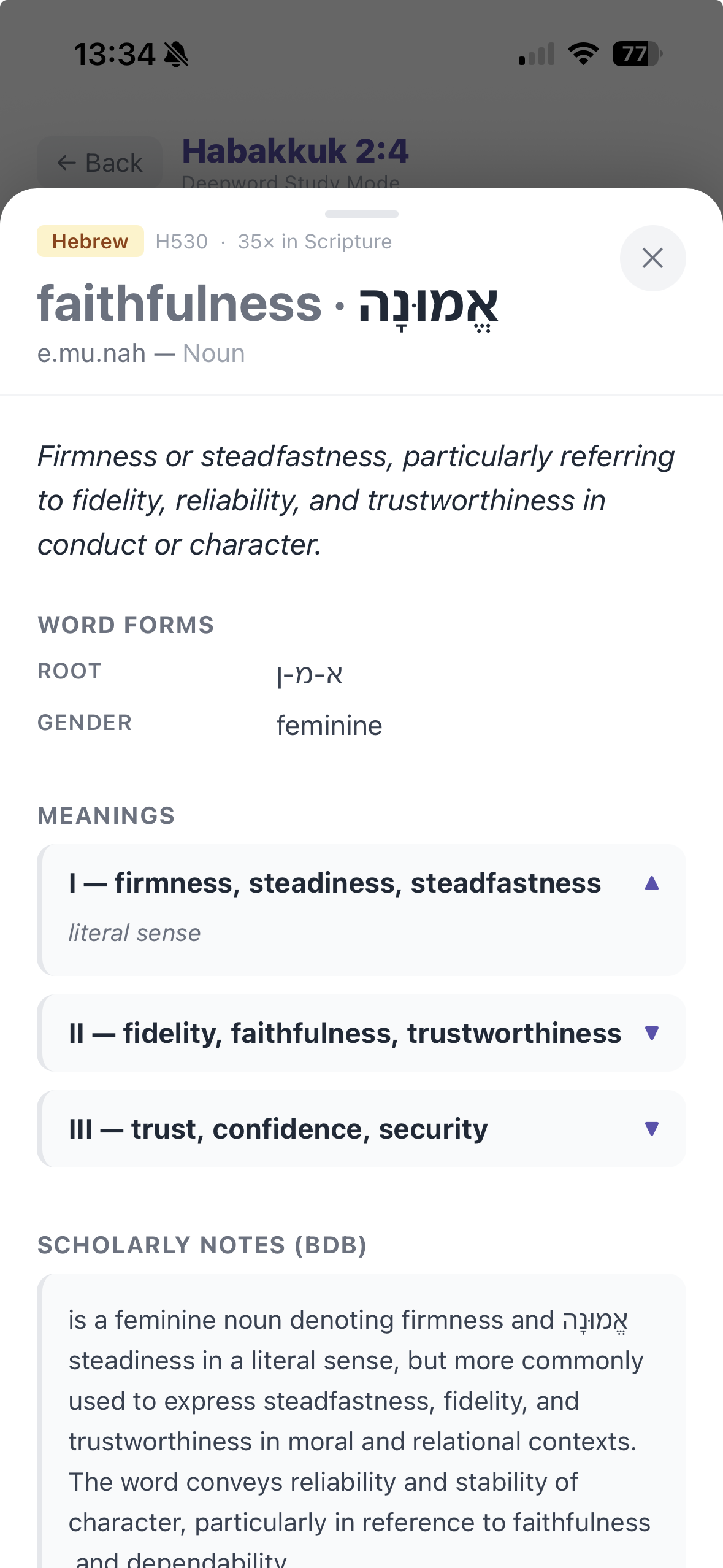
The Hebrew is אֱמוּנָה — emunah (Strong's H530), a feminine noun that turns up 49 times in the Old Testament.
It is built on the three-letter root a-m-n. The verb from that root, aman, doesn't mean to believe in the modern sense at all. It means to support, to uphold, to carry, to make firm. In one form it's the word for the pillars that hold a door up. In another it's the word for a nurse or a foster-father: when Moses complains in Numbers 11:12 about hauling a whole nation around, the phrase is "as a nursing father beareth the sucking child" — and nursing father there is this root. Arms that carry something that cannot carry itself.
And you have said this root out loud your whole life. Amen comes from it. When you end a prayer, you are not saying I hope so. You are saying firm — let it hold.
Its plain meaning: a thing that holds.
The lexicon's plain sense for emunah is short and physical: firmness, steadiness, reliability.
That is a structural word before it is a religious one. It's what you'd say about a table leg, a rope, a wall, a bridge — and then, by extension, about a person who behaves like one.
English went the other way. Our word faith has drifted inward over the centuries until it now names something that happens behind your eyes: a belief you hold, a conviction you maintain without proof. Ask an English speaker to picture faith and they picture someone thinking hard, or trying to.
Ask a Hebrew speaker to picture emunah and they picture something not moving.
And the lexicon lays it out plainly.
Open the full entry on emunah in DeepWord and the order of the senses is the surprise. Sense one isn't spiritual at all — it is literal, physical steadiness, and the example given is Exodus 17:12, a pair of arms. Sense two is steadfastness: enduring stability in circumstances, and it points to Isaiah 33:6, where emunah is translated "the stability of thy times."
Only at sense three do you reach faithfulness and trustworthiness — and even there the entry splits it in two: human reliability (holding an office, handling money, keeping your word) and God's own reliability (his promises, his covenant, his character). Habakkuk 2:4 sits in that third sense.
Which means the word arrives at "faith" only after it has already meant steady arms and a stable era. The abstraction is the last stop, not the first.
Follow it around and it stops sounding abstract.
Forty-nine occurrences, and the King James renders this one noun as faithfulness, truth, faithfully, faithful, truly, verily, stability, set office, steady — and, once, faith.
Take set office first, because it's the strangest. In 1 Chronicles 9 the temple staff — the gatekeepers, and the Levite responsible for what came out of the baking pans — are three times described as being "in their set office." The Hebrew is be'emunah: literally in their steadiness. It means they were at their post. Whatever else the word carries, it is the phrase the Bible uses for showing up and being where you said you'd be.
Then the money. Twice — 2 Kings 12:15 and 2 Kings 22:7 — the men handling the temple repair funds are described with this word, and both times the point is the same: nobody counted it afterwards. "There was no reckoning made with them of the money that was delivered into their hand, because they dealt faithfully." Emunah is the quality that makes an audit unnecessary.
Then Isaiah 33:6: "wisdom and knowledge shall be the stability of thy times." Same noun. A steady era.
Then Proverbs 28:20, where "a faithful man" is, word for word, a man of emunahs — the noun in the plural, as though steadiness were something you accumulate.
And then the other half of the picture, which is most of it. Twenty-two of the forty-nine are in the Psalms, seven of them in Psalm 89 alone, and there the word almost always belongs to God: "thy faithfulness reacheth unto the clouds" (Psalm 36:5). Including one line you may have sung. Lamentations 3:23 — "They are new every morning: great is thy faithfulness" — is emunah. It sits one verse after Lamentations 3:22, which is the great chesed verse. Jeremiah put God's loyal love and God's steadiness back to back, in that order.
Moses' hands were "faith" until the sun went down.
Now the verse that makes the whole word land.
Exodus 17. Israel is fighting Amalek in the valley, and Moses is on the hill with his hands raised. While his hands are up, Israel is winning. When they come down, Amalek is winning. And then, inevitably, his arms give out — "Moses' hands were heavy."
So they put a stone under him and sit him down, and Aaron takes one arm and Hur takes the other, "the one on the one side, and the other on the other side; and his hands were steady until the going down of the sun" (Exodus 17:12).
Steady is emunah. The bare noun, no adjective. Word for word, the Hebrew says: and his hands were faith until the sun went in.
Read that slowly, because of what it admits. Moses' hands were steady — and they were not steady on their own. They had already failed. The steadiness in that sentence is real, and it is entirely borrowed: two men, one on each side, holding up a tired old man's arms so that the thing could hold until dark.
None of this settles the long argument over Habakkuk's line — whether "his emunah" means the righteous man's trust, or the righteous man's reliability, or God's own faithfulness holding the righteous man up. That is a question about a whole sentence and three New Testament quotations of it, not about one noun, and honest readers have landed in different places for centuries. It's worth knowing that every New Testament writer who quotes this line in Greek reaches for the same noun — pistis — and pistis carries both sides too: active trust in one sense, fidelity and faithfulness in another. The double meaning isn't something English introduced. It was already there, in both languages.
What the Hebrew adds is not a ruling. It's a picture. Whatever else faith is, the word Habakkuk reached for is the word for a doorpost, a nurse's arms, a gatekeeper at his post, a treasurer nobody had to check — and a pair of arms held up past the point of exhaustion, by somebody else, until the sun went down.
Not a word about being sure. A word about holding on. And you say its root every time you finish a prayer.