Genesis 1:1 is the first sentence in the Bible, and probably the most familiar line ever written. "In the beginning God created the heaven and the earth." We read the word created and picture God making something — the way a potter makes a bowl or a carpenter makes a chair. Building. Assembling. Making.
Then one day I tapped the word created — and found out the Hebrew is hiding something the English can't show you. It's not just a word for making. It's a word that, in this form, has only ever had one subject in the whole Hebrew Bible: God.
The verse you think you already know.
"In the beginning God created the heaven and the earth." Six words of setup and the universe exists. It's the verse on the first page of every Bible, so familiar we read straight over it. Today, stop on the word created.
The translators quietly disagree.
Line up a few translations and the verb itself holds steady — "created" almost everywhere. But look closer and the fault line shows up around it: some newer versions reshuffle the grammar to "When God began to create…" or "In the beginning, when God created…". That scramble happens precisely because translators are wrestling with a verb that doesn't behave like ordinary making. English only has one gear for it — "created" — and it quietly flattens something the Hebrew keeps sharp.
The word Moses actually wrote.
The Hebrew is בָּרָא — bara (Strong's H1254). It is not the ordinary word for making. Hebrew has plenty of those: asah, to make or do; yatsar, to form or shape, the word for a potter working clay. Those are the everyday verbs, and people do them all the time — we make, we build, we shape. Bara is different. It stands apart.
Its plain meaning: to create — but only God does it.
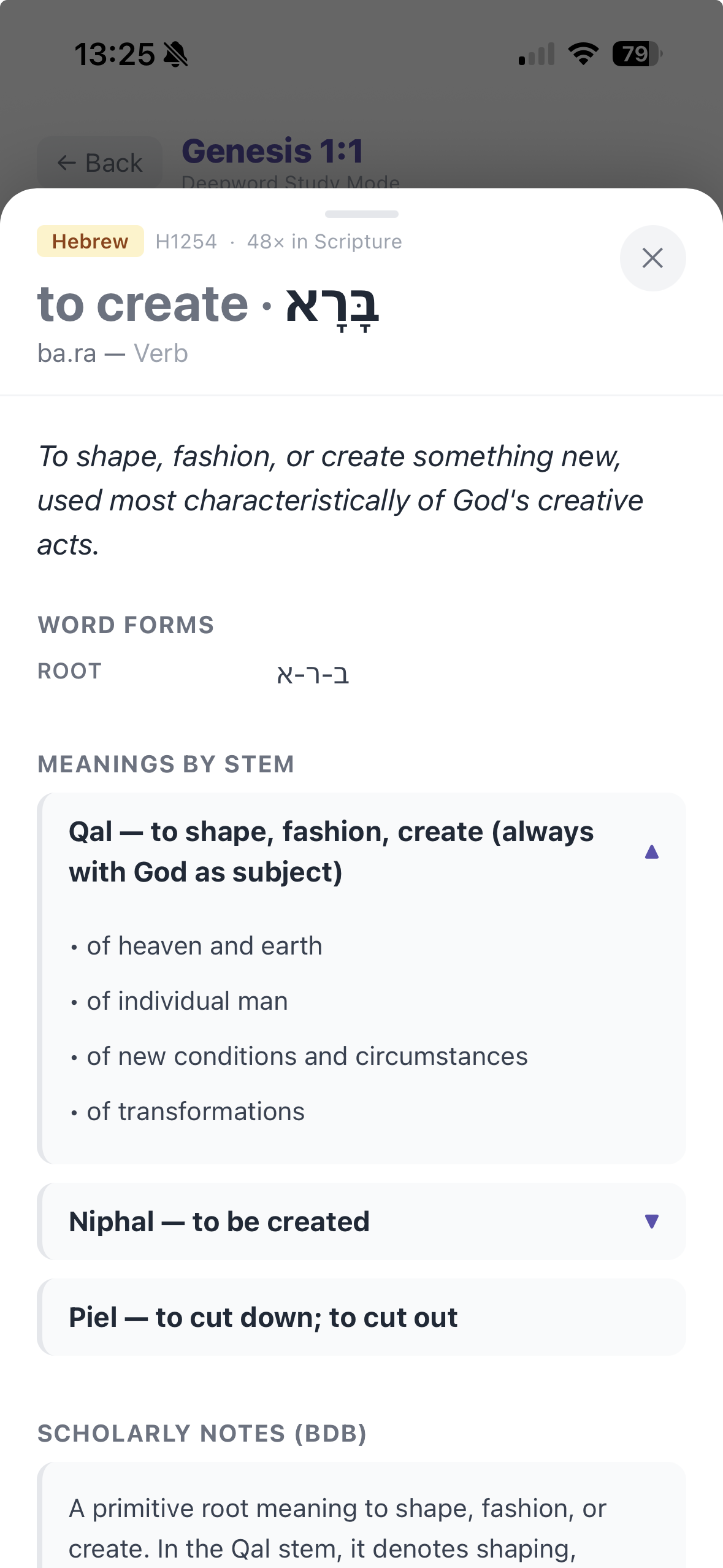
Here is the thing English can't tell you. In its basic form, bara only ever takes God as its subject. Search the entire Hebrew Bible and you will never find a person, a craftsman, or an idol who bara. Humans asah and yatsar — they make and shape, always out of some material already lying around. But bara comes with no clay, no workshop, no pile of leftover scraps. There's no raw material named because there wasn't any. It's making of a kind only God can do.
And the lexicon confirms the twist.
Open the full lexicon entry on bara in DeepWord and it's right there in plain sections: the verb, in this form, is used exclusively of divine activity — God is always the one doing it. No exceptions, across the whole Old Testament. The lexicographers noticed the same pattern anyone reading Hebrew notices: this is a verb reserved for God alone.
See it everywhere else it appears.
Once you know it, bara lights up across the Bible — and always at the hinges. God bara the great sea creatures (Genesis 1:21). God bara humankind (Genesis 1:27). Isaiah has God saying, "I form the light, and bara darkness" (Isaiah 45:7). And then the one that lands closest to home: David's prayer, "Bara in me a clean heart, O God" (Psalm 51:10). He doesn't ask God to repair his heart or renovate it. He uses the creation verb — the one only God can do. A clean heart isn't a fix-up job. It's a brand-new thing, made from nothing, by the only One who can.
The picture Moses actually painted.
So Genesis 1:1 isn't a picture of God in a workshop, assembling the universe out of parts that were already there. The very first verb chosen for the very first act tells you otherwise. Bara is making that belongs to God alone — origination, not construction. Everything else in the chapter gets built from what this verb brings into being.
You've read "In the beginning God created" your whole life. It took the Hebrew to hear the claim underneath it — that the making itself is something only God has ever done.