"Helper" is a small word in English. It's the kid handing you tools while you fix the sink. It's the extra pair of hands, the assistant, the one who isn't doing the actual job.
So when Genesis says God made the woman to be a helper, English quietly hands us a picture of someone standing slightly behind. That picture is not in the Hebrew. In fact, most of the time this word shows up in the Old Testament, the helper it's describing is God.
The verse, and the strange thing that happens right before it.
Genesis 1 has a rhythm you can feel: God makes something, God looks at it, and God calls it good. Light, good. Land and sea, good. Living creatures, good. At the end of the sixth day, everything together — very good.
Then comes Genesis 2:18, and for the first time in the Bible, something is not good. "And the LORD God said, It is not good that the man should be alone; I will make him an help meet for him."
That's the setup. The first flaw in a finished world is loneliness, and God's answer to it is one Hebrew word.
Here the translations quietly disagree.
Open Genesis 2:18 in ten English Bibles and watch them scatter. The KJV, RNKJV and ASV keep the old phrase: "an help meet for him." The BSB says "a suitable helper." The NHEB says "a helper suitable for him." The WEB says "a helper comparable to him." The LEB says "a helper as his counterpart." Young's Literal says "an helper — as his counterpart." Darby tries "a helpmate, his like." The BBE gives up on a single phrase entirely: "one like himself as a help to him."
Suitable. Comparable. Counterpart. His like. One like himself. The translators aren't confused about the first word — they're all fighting the same losing fight with the second one. Because there are two Hebrew words here, and English keeps trying to squeeze them into one.
The words Moses actually used.
The Hebrew is עֵזֶר כְּנֶגְדּוֹ — ezer kenegdo.
Ezer (Strong's H5828) is a noun built on the verb azar — to help, to come to someone's aid, to show up for a person who cannot manage alone. It's the whole first word. And it appears in the Hebrew Bible exactly 21 times.
Its plain meaning: count who it's actually about.
Two of those 21 are our verse and the one that echoes it a few lines later (Genesis 2:18 and 2:20) — the woman.
Three of them are about human help that turns out to be thin: Egypt, who "could not profit them, nor be an help" (Isaiah 30:5); the guard around a doomed king (Ezekiel 12:14); a persecuted people "holpen with a little help" (Daniel 11:34).
The remaining sixteen are God.
"Our soul waiteth for the LORD: he is our help and our shield" (Psalm 33:20). "My help cometh from the LORD, which made heaven and earth" (Psalm 121:2). "Our help is in the name of the LORD" (Psalm 124:8). "Happy is he that hath the God of Jacob for his help" (Psalm 146:5). "There is none like unto the God of Jeshurun, who rideth upon the heaven in thy help" (Deuteronomy 33:26). "O Israel, thou hast destroyed thyself; but in me is thine help" (Hosea 13:9).
Not once in twenty-one appearances does ezer mean a subordinate. It never once describes a servant, an underling, or an assistant. It's a rescue word.
And the lexicon shows you the company it keeps.
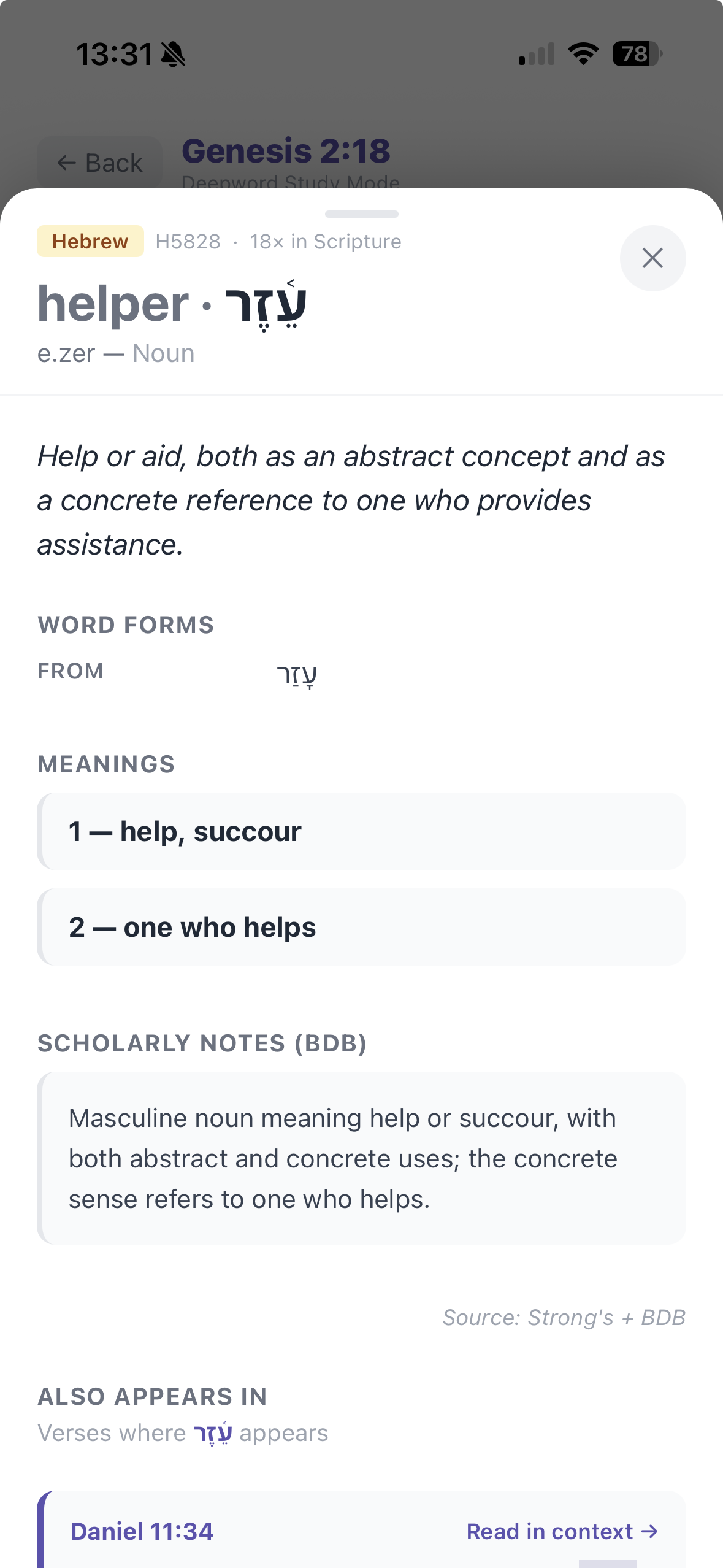
Open the full entry on ezer in DeepWord and you can see the two branches of the word laid out plainly: the abstract sense — aid, rescue, succour in a time of need — and the concrete one, a person who is that help. The entry notes what the concordance confirms: the concrete sense lands most often on God, "helper and shield."
That pairing is worth sitting with. Four times the phrase is "help and shield" (Psalm 33:20; Psalm 115:9, 10, 11). Once it's "the shield of thy help, and... the sword of thy excellency" (Deuteronomy 33:29). Ezer travels with shields and swords. It does not travel with brooms.
Every place it appears — including two names you already know.
Once you can see ezer, it starts turning up in places you'd never connect.
Moses had two sons. He named the second one Eliezer — El ("my God") plus ezer — and Exodus tells you exactly why: "the name of the other was Eliezer; for the God of my father, said he, was mine help, and delivered me from the sword of Pharaoh" (Exodus 18:4). A man who escaped an empire named his child my God is my ezer.
And after a battle at Mizpeh, "Samuel took a stone... and called the name of it Eben-ezer, saying, Hitherto hath the LORD helped us" (1 Samuel 7:12). Eben is stone. Ezer is help. A stone of help — a rock dragged upright in a field so nobody would forget who showed up. If you've ever sung "here I raise mine Ebenezer" and had no idea what you were singing, that's it. You were raising a monument to ezer.
Same word. The one in Genesis 2:18.
What English lost on the way here.
Two things went missing, and both are small enough to slip past you.
The first is a printing accident. In 1611, "help meet" was two words: meet was an ordinary English adjective meaning fitting, suitable, a match for. "An help meet for him" meant "a help suitable for him." Over the centuries readers fused the two into "helpmeet," and then softened that into "helpmate" — inventing an English word that never existed in Hebrew, and shrinking a strong noun into a domestic one along the way.
The second is the word "meet" was translating: kenegdo, from neged (H5048), which means in front of, opposite, facing. Not behind. Not underneath. Corresponding to — the lexicon's own phrase for this construction is "equal and adequate to." That's why LEB and Young's both reach for "counterpart," and why the WEB says "comparable to him." A help standing face to face with him, matched to him, the missing half of a pair.
None of that settles the long arguments people have about roles in a marriage — that's a conversation about many passages, not one noun. But it does settle what the noun itself carries. Ezer is not a word that means lesser. It's the word Israel used when it sang about the God who came running.
Which is the quiet joke at the front of the whole Bible. Eleven verses earlier, God breathes into dust and the man becomes a living nephesh. Then the God who bara'd the universe out of nothing looks at his finished world, finds one thing wrong with it, and fixes it by making someone strong enough to be called by his own title.
It was never "here's an assistant." It was "you are not going to face this alone."