We talk about the soul like it's something we keep inside us — a ghost in the machine, the real you hiding somewhere behind your ribs, waiting to slip out when the body quits. It's such a familiar idea that we read it straight into the second chapter of the Bible without noticing.
But the word under "soul" in Genesis 2:7 doesn't point to a part of you at all. I tapped it expecting the immortal spark we all talk about. What I got was earthier, stranger, and somehow far more hopeful.
The verse you think you already know.
"And the LORD God formed man of the dust of the ground, and breathed into his nostrils the breath of life; and man became a living soul." Dust in God's hands, breath in the nostrils, and then — life. Today, stop on those last two words: living soul.
The translators quietly disagree.
Line up a few translations and the ending of the verse shifts under your feet. The old King James says man "became a living soul." But most modern translations — and most scholars — say man "became a living being," or even a living creature. Soul, being, creature: those are three very different pictures of what just happened in the dust. The translators aren't being careless. They're wrestling with one Hebrew word that English has never had a clean home for.
The word Moses actually wrote.
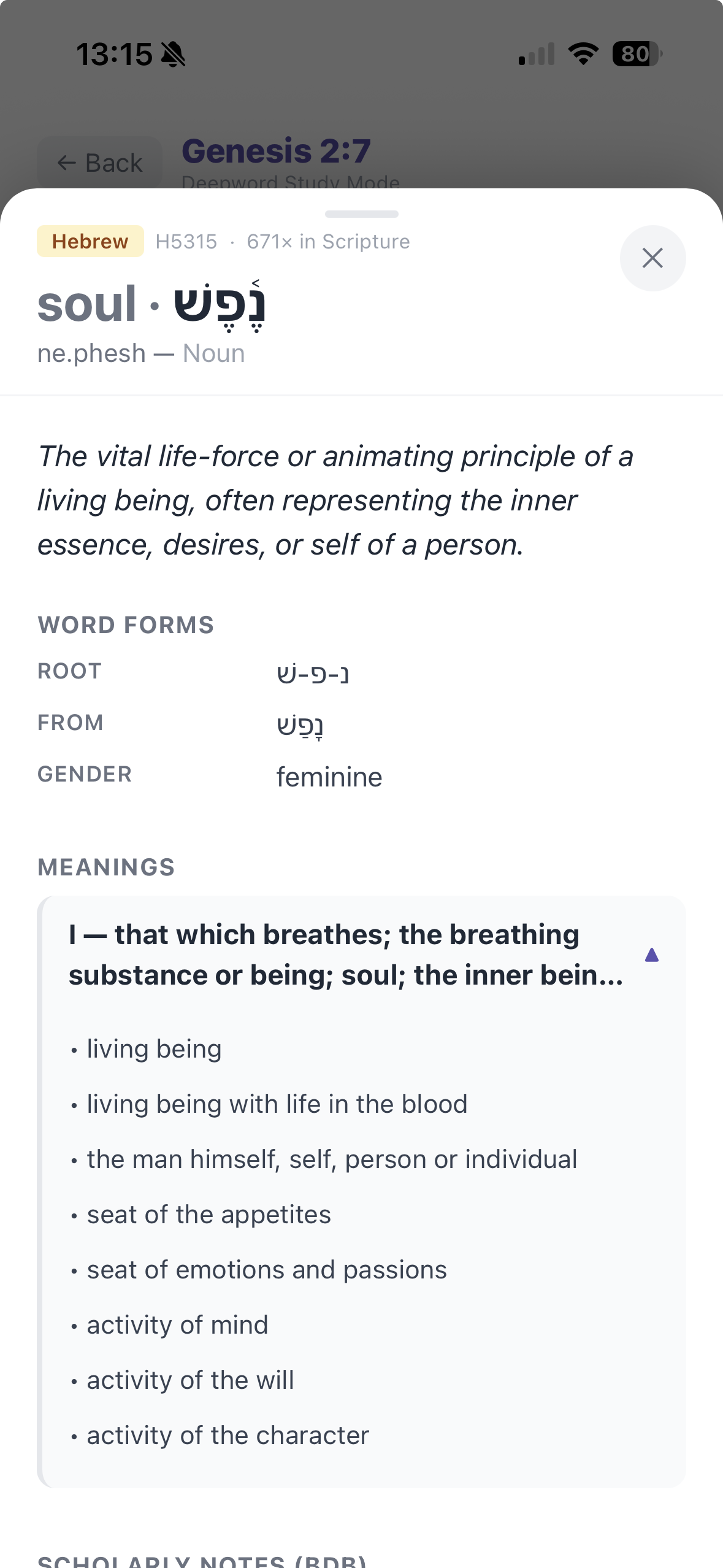
The Hebrew is נֶפֶשׁ — nephesh (Strong's H5315). It appears more than 750 times in the Hebrew Bible, and your English Bible renders it dozens of ways: soul, life, person, self, heart, mind, appetite, desire — even throat. It refuses to be just the immortal inner spark. At its root, nephesh is tied to breathing and to the throat — the place where breath, hunger, and thirst all pass through. It's the whole hungry, breathing, living self.
Its plain meaning: the whole living self.
Strip it to the core and nephesh is a living, breathing being — the entire self, not a piece of it. That's the shock of Genesis 2:7. God shapes the dust, breathes into it, and the man doesn't receive a soul. He becomes a nephesh. Body plus breath equals a living being. You don't have a nephesh tucked inside you — body and life together, the whole of you, is a nephesh.
And the lexicon confirms it.
Open the full lexicon entry on nephesh in DeepWord and you can watch the scholars trace it from the ground up. It starts at the body — the throat, the breathing, swallowing passage ("the grave opened wide its nephesh," its gullet). From there it widens to appetite and desire — the part of you that hungers and longs. Then to life itself, the living breath that makes a body a being. Then to the seat of emotion and will — what we'd call the heart. And only at the far end, the whole person, the self, the "soul." One word, one unbroken line from your throat to your deepest longing.
That order matters. The standard Hebrew lexicon (Brown-Driver-Briggs) doesn't begin with the spiritual and reluctantly admit the physical. It begins in the body and builds up. To the Hebrew writer there was no clean wall between your breath, your hunger, and your soul. They were one living thing.
See it everywhere else it appears.
Once you know the word, you can't unsee it. Two chapters earlier, the same phrase — nephesh chayyah, "living being" — is used of the fish and the birds and the animals. The creatures of the sea are nephesh too. Whatever a soul is, Genesis hands one to the herring before it hands one to Adam. And listen to the Psalms with this word in your ear: "As the deer pants for streams of water, so my nephesh pants for you" — that's the throat, the thirst, the whole self aching. "Bless the LORD, O my nephesh" — not "O my immortal part," but all of me, everything I am.
The picture Moses actually painted.
So Genesis 2:7 isn't a story about God installing a soul into a body like a battery into a flashlight. It's a story about dust that learned to breathe. You are not a soul trapped in a body, biding your time. You are a nephesh — a living, breathing, hungering whole, dust that God filled with his own breath. Every craving, every ache, every lungful of air is part of the self God made.
You've read this verse your whole life. It took one word, in the original, to turn "a living soul" from a ghost in your chest into the whole of you — body, breath, and longing — alive in the hands of God.