"It is finished." Three small words, the last thing Jesus says from the cross in John 19:30. In English they sound like the end of a long, losing struggle — a man at the limit of his strength, breathing out it's over. Resignation. The lights going out.
But that's three English words standing in for a single Greek one. And that one word isn't the language of defeat at all. It's the language of a ledger — the word a merchant stamped across a bill the day it was settled.
The verse you think you already know.
"When Jesus therefore had received the vinegar, he said, It is finished: and he bowed his head, and gave up the ghost." We read "it is finished" and hear a dying whisper — the story closing, the worst happening. It's the line we say in a hospital hallway when there's nothing left to do. Today, stop on that word finished.
The translators quietly disagree.
Look across a few Bibles and you catch the hesitation. Most say "It is finished." But others reach for "It is accomplished" or "It is completed" — and that's a different flavor entirely. Finished can mean simply over, done with. Accomplished means a task carried all the way to its goal. One is a man giving out. The other is a man giving the verdict that the job is done.
The word Jesus actually spoke.
The Greek is τετέλεσται — tetelestai (from teleō, Strong's G5055). One word, not three. Its root, telos, means a goal, an end, the point everything was aimed at. So teleō doesn't mean "to stop." It means to bring something all the way to its intended finish — to complete, to fulfill, to carry out to the full.
Its plain meaning: completed, fulfilled — and paid.
Here's the detail most readers never hear. Teleō was also an everyday business word. It's the verb used for paying what you owe — Jesus' followers teleō the temple tax in Matthew 17:24; Paul tells believers to teleō their taxes in Romans 13:6. To "finish" a debt, in Greek, is to pay it off. So tetelestai carries a second meaning the English can't: not only it is completed, but the account is settled.
And the lexicon confirms the twist.
Open the full lexicon entry on tetelestai in DeepWord and two things jump out. First, the commercial sense is right there: teleō means to pay, to discharge a debt — and archaeologists have found this exact word, tetelestai, written across tax receipts and business documents from the ancient world, meaning "paid in full." Second — and this is the quiet thunderclap — the word is in the perfect tense. Greek has a special tense for an action that is finished and whose result goes on standing. Not "it happened" but "it has been completed, and it remains complete."
That's the reversal hiding in three soft English words. Jesus isn't reporting that his life is running out. He is announcing that a work has been brought to its goal — and that it will never need doing again.
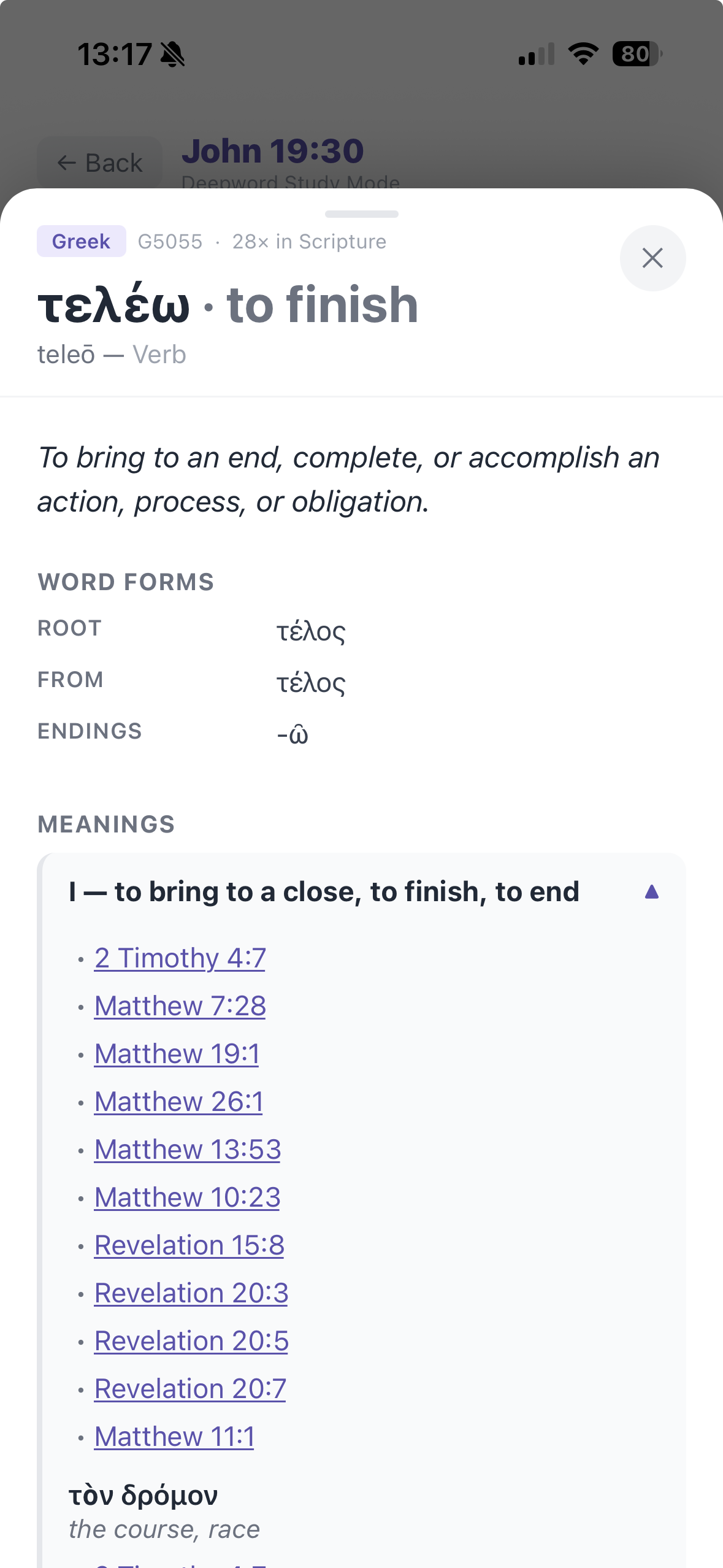
See it everywhere else it appears.
Once you know the word, you hear it echo. The night before, Jesus prays "I have finished the work you gave me to do" (John 17:4) — same root, the task complete. Paul, at the end of his life, writes "I have finished the race" (2 Timothy 4:7). It's the word for paying the temple tax, for settling the bill, for crossing the last item off the list. Around two dozen times in the New Testament, teleō means a thing carried all the way to its end — never simply abandoned.
The cry Jesus actually gave.
So John 19:30 isn't the whimper of a defeated man. It's closer to a shout of victory: the work is done, the debt is settled, and — because of that perfect tense — it stays done. Nothing left owing. Nothing to add. (If you've read our study of agape in 1 John 4:8, the self-giving love that defines God, tetelestai is what that love looks like when it pays the whole price itself.)
You've heard "It is finished" your whole life as a sad, final breath. It took one Greek word to show it's actually a receipt — held up to the world and stamped, once and for all, paid in full.