"God is love." Three of the most quoted words in the Bible, straight out of 1 John 4:8. They're printed on mugs and wedding programs and worship slides. In English they land warm and a little soft — love, the same word we use for a favorite show, a slice of pizza, a spouse, a dog.
But the Greek word behind that last "love" isn't the obvious one. The New Testament writers had several words for love to choose from. They reached, again and again, for the plainest and rarest of them — the one with the least romance in it. And that choice is the whole point.
The verse you think you already know.
"Beloved, let us love one another: for love is of God… He that loveth not knoweth not God; for God is love." It's the verse weddings borrow and worship songs repeat until we can finish it from memory. We read "love" and quietly fill it in with whatever love we already know — a feeling, a fondness, a warmth in the chest. Today, stop on that word.
The translators quietly disagree.
Watch English show its seams. Where modern Bibles say "love," the King James often said charity — most famously in 1 Corinthians 13: "though I speak with the tongues of men and of angels, and have not charity…" Same Greek word, two very different English words, four centuries apart. Translators keep reaching for new words because English has exactly one — love — for a dozen different things. Greek did not.
The word John actually wrote.
The Greek is ἀγάπη — agape (Strong's G26). And here's the surprise: Greek had a whole family of love-words. Eros for desire and romance. Philia for the warm bond between friends. Storge for the natural affection of family. Agape was the quietest of them — so uncommon in everyday Greek that the lexicons call it almost a Bible word. That's the one the New Testament chose, over and over.
Its plain meaning: a love you decide, not a love you feel.
At its core, agape is love that chooses its object — a settled, self-giving goodwill, not a mood that rises and falls. It's the love you can be commanded to have ("love your enemies"), which is nonsense for a feeling and perfect sense for a decision. Not the love that happens to you. The love you choose to give, especially to someone who hasn't earned it.
And the lexicon confirms the shift.
Open the full lexicon entry on agape in DeepWord and you see what makes it strange. The standard Greek lexicon (Thayer's) flags it as "a purely Biblical and ecclesiastical word" — rare in ordinary Greek, where writers usually reached for other terms. And it's blunt about what the word is and isn't: it is never used of romantic passion, and only rarely of natural affection. What's left, the entry says, is "a holy, self-giving disposition that originates in God."
That's the reversal hiding inside three small words. When John writes "God is love," he isn't reporting on God's mood. He's saying that the self-giving, self-emptying kind of love — the kind that chooses you before you've done a thing to deserve it — is what God simply is.
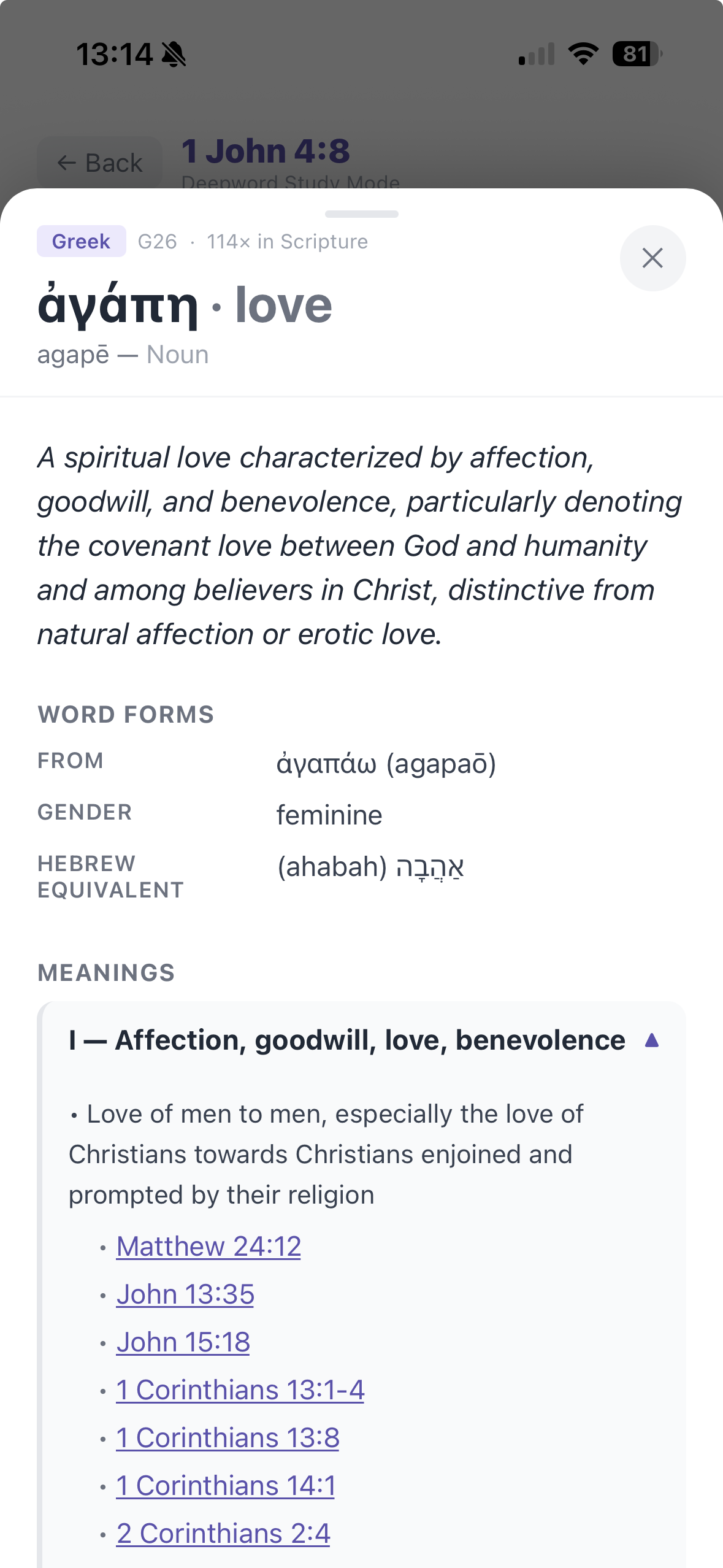
See it everywhere else it appears.
Once you know agape, you find it holding up the whole New Testament — it appears around 116 times. It's the "love" that "is patient" and "is kind" in 1 Corinthians 13. It's the love of John 3:16, "God so loved the world that he gave." It's Romans 5:8 — "while we were still sinners, Christ died for us." Every time, the same fingerprint: a love measured not by what it feels but by what it gives up.
The picture John actually painted.
So 1 John 4:8 isn't a soft sentiment for a greeting card. It's a definition. And John refuses to leave it floating in the abstract — in the very next breath he tells you how to spot this love: "This is how God showed his love among us: He sent his one and only Son." (If you've read our study of chesed in Lamentations 3:22, the Hebrew word for God's loyal, covenant-keeping love, agape is its New Testament cousin — the love that keeps its promise by giving itself away.)
You've read "God is love" your whole life. It took one Greek word to show that it isn't a warm feeling God happens to have. It's the thing God does — and the thing he is.