We use compassion like a warm, tidy word. It fits on a greeting card. You can feel compassion for a stranger's bad day and then finish your coffee. It's sympathy with good manners — real, but safe, and kept at arm's length.
The Greek word underneath it is nothing like that. It doesn't happen in your head or even your heart. It happens in your gut — a physical churn, a twist in the insides, the thing you feel when you see something so pitiful your whole body reacts before your mind does. English quietly cleaned it up. Here's the word Mark actually wrote.
The verse you think you already know.
"And Jesus, when he came out, saw much people, and was moved with compassion toward them, because they were as sheep not having a shepherd: and he began to teach them many things" (Mark 6:34). We read "moved with compassion" and picture a kind look, a soft heart. But Mark is describing something that hit Jesus in the body — a wave that came up from the inside the moment he saw the crowd. Today, stop on that phrase, because the original is far more physical than the English lets on.
The translators reach for the body — and still fall short.
"Moved with compassion," says the King James. Others try "he had compassion on them," or "his heart went out to them." Notice how each one gropes toward the body — moved, heart — because the translators can feel there's something visceral here they can't quite say in polite English. The truth is, our language simply doesn't have a clean word for it. So we settle for "compassion" and lose the churn.
The word Mark actually used.
The Greek is σπλαγχνίζομαι — splagchnizomai (Strong's G4697). It comes from splanchna, the word for your inward organs — the heart, liver, lungs, the guts. To the ancient world, that deep interior wasn't just plumbing; it was where the strongest feelings lived. So the verb literally means to be moved in the guts — to have your insides wrench. It's the body's word for pity, not the mind's.
Its plain meaning: a churn in the insides, not a polite nod.
The lexicons put it bluntly: splagchnizomai is "to be moved as to one's bowels" — the bowels being "the seat of love and pity" — and so, "to be moved with compassion, to have the inward parts yearn." This is the strongest word for pity the Greek language had. It isn't a feeling you decide to have. It's a feeling that happens to you, low and involuntary, the moment you see someone truly helpless. Not "that's a shame." More like the punch you feel in your stomach when you see a lost child crying in a crowd.
And the lexicon confirms the churn.
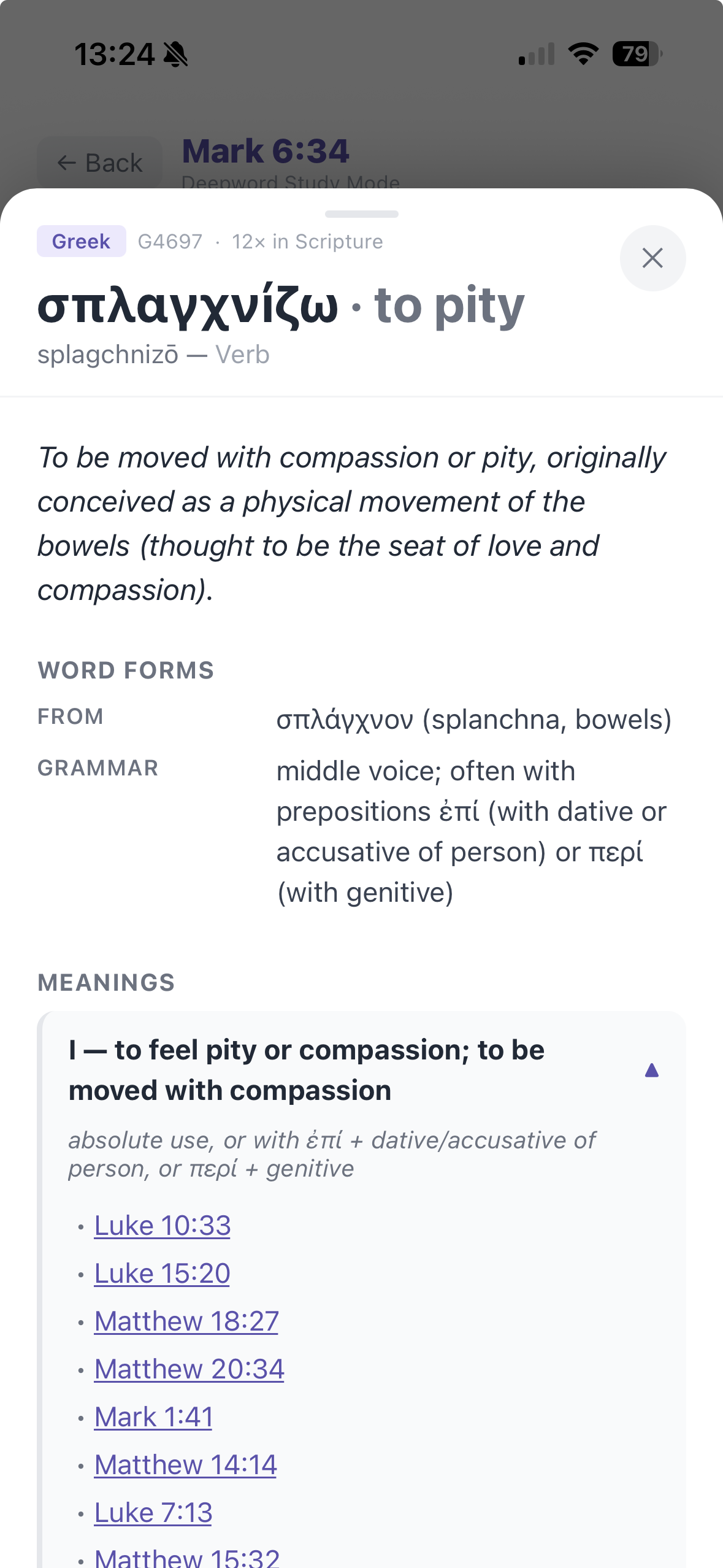
Open the full entry on splagchnizomai in DeepWord and the picture sharpens. The root splanchna is concrete and physical — the inner organs, the deep interior of a person — and the verb built on it means those insides are moved, stirred, wrenched. Then look at what set it off in Mark 6:34: a crowd "as sheep not having a shepherd." Sheep without a shepherd don't just wander; they're defenseless, exposed, headed nowhere. Jesus doesn't glance at that and feel a tidy sympathy. He sees it and something turns over inside him — and then he begins to teach.
That's the order the verse gives us: the gut-churn first, the help second. The teaching isn't duty. It's what the churn drives him to do.
See who else it happens to.
Here's the detail that changes everything. This word appears twelve times in the Gospels — and almost every single time, the one whose guts are wrenching is Jesus. He is "moved" at the sight of the sick (Matthew 14:14), the harassed and helpless (Matthew 9:36), a leper (Mark 1:41), a grieving widow (Luke 7:13). The only other times it shows up, it's on the lips of Jesus telling a story — and it always lands on the God-figure: the Samaritan who stops for the beaten stranger (Luke 10:33), the father who sees his lost son "yet a great way off" and feels it in his guts and runs (Luke 15:20). This isn't a word for how we usually feel. It's a word for how God feels when he sees us.
The word behind the polite one.
So Mark 6:34 isn't a mild scene of a kind teacher. It's a picture of God looking at a wandering, shepherdless crowd and being physically undone by it — insides churning, unable to leave them as they are. (If you've read our study of chesed in Lamentations 3:22, the loyal love that refuses to quit, splagchnizomai is what that love feels like in the body — love with a churn in its guts.)
You've heard "compassion" your whole life as a gentle, distant word. It took one Greek word to show that when God looks at you helpless, what he feels isn't distant at all. It's a wrench in the guts — and it moves him to come close.