Here are two lines from two different books of the Old Testament, in the King James Version.
Deuteronomy 32:7: "Remember the days of old."
Micah 5:2, about the ruler who will come out of Bethlehem: "whose goings forth have been from of old, from everlasting."
One phrase looks back into history. The other looks past the beginning of the world. In Hebrew, both are built from the same two nouns — literally, days of olam.
The verse — in the one translation that doesn't hide it.
Here is Psalm 90:2 in the Bible in Basic English:
"Before the mountains were made, before you had given birth to the earth and the world, before time was, and for ever, you are God."
Read the middle of that again. Before time was. And for ever.
Two different phrases, pointing in opposite directions — one back behind the start of everything, one forward without end. You would reasonably assume they translate two different Hebrew words.
They don't. They are the same word, used twice, back to back.
Psalm 90 is the one psalm traditionally credited to Moses, and it is a psalm about how short we are. A few verses on comes the line everybody knows: "the days of our years are threescore years and ten" (90:10). Seventy years, eighty if you're strong, and then "we fly away." Verse 2 is the counterweight. Against seventy years Moses sets God — and to do it he takes one noun and points it both ways at once.
Nine translations flatten it. One shows its working.
Line up the ten translations in DeepWord at this verse and something quietly consistent happens.
The King James, the Restored Name KJV, the ASV, the Berean Standard, the Lexham, the New Heart and the WEB all say "from everlasting to everlasting." Darby says "from eternity to eternity." Young's Literal says "from age unto age."
Three different English words — but look at the shape of all nine. Each one picks a single word and uses it twice. That is a perfectly fair translation, and it is also the exact moment the information goes missing. Once "everlasting" is sitting in both slots, nothing on the page can tell you that the second one is facing the other way.
Only the Bible in Basic English breaks the pattern: "before time was, and for ever." It didn't so much translate the phrase as unfold it — and in doing that, it told you in plain English what the Hebrew had been doing all along.
(It's the same reason this one word turns up in your Bible as for ever, everlasting, evermore, perpetual, never, always — and also as ancient and of old. Which English word lands on the page is the translator's call, verse by verse.)
The word Moses actually wrote.
The Hebrew is עוֹלָם — olam (Strong's H5769), a masculine noun that appears 438 times in the Old Testament, spread across 34 of its books.
In Psalm 90:2 it is there twice, in one short clause: me'olam ad olam — from olam to olam. Same noun both times. The only difference is the little preposition in front of the first one, pointing it backwards.
And the root underneath it is not a time word at all. Olam comes from the verb alam (H5956), which means to veil from sight, to conceal. It's the verb for hiding something, or for looking away.
Its plain meaning: the horizon.
Strong's own entry puts it in three words that are hard to improve on. Olam, it says, is "properly, concealed, i.e. the vanishing point; generally, time out of mind (past or future)."
Here is the difference, as plainly as it can be put.
Our English words for it — for ever, everlasting, eternal — are all measurements. They answer the question how long?, and the answer they give is endlessly. They're the kind of word you could put in an equation.
Olam is not answering that question at all. Olam is the word for the horizon.
And a horizon is not a distance. It's the place where your looking stops. It isn't a spot on the map — nobody has ever walked to one — and if you set off towards it, it moves. That's the whole idea. A horizon doesn't describe the land. It describes the limits of the person standing there.
Which is why one word can face both directions without any strain. The horizon behind you works exactly like the horizon ahead of you. Both are simply the place where your seeing gives out.
And the lexicon lays it out plainly.
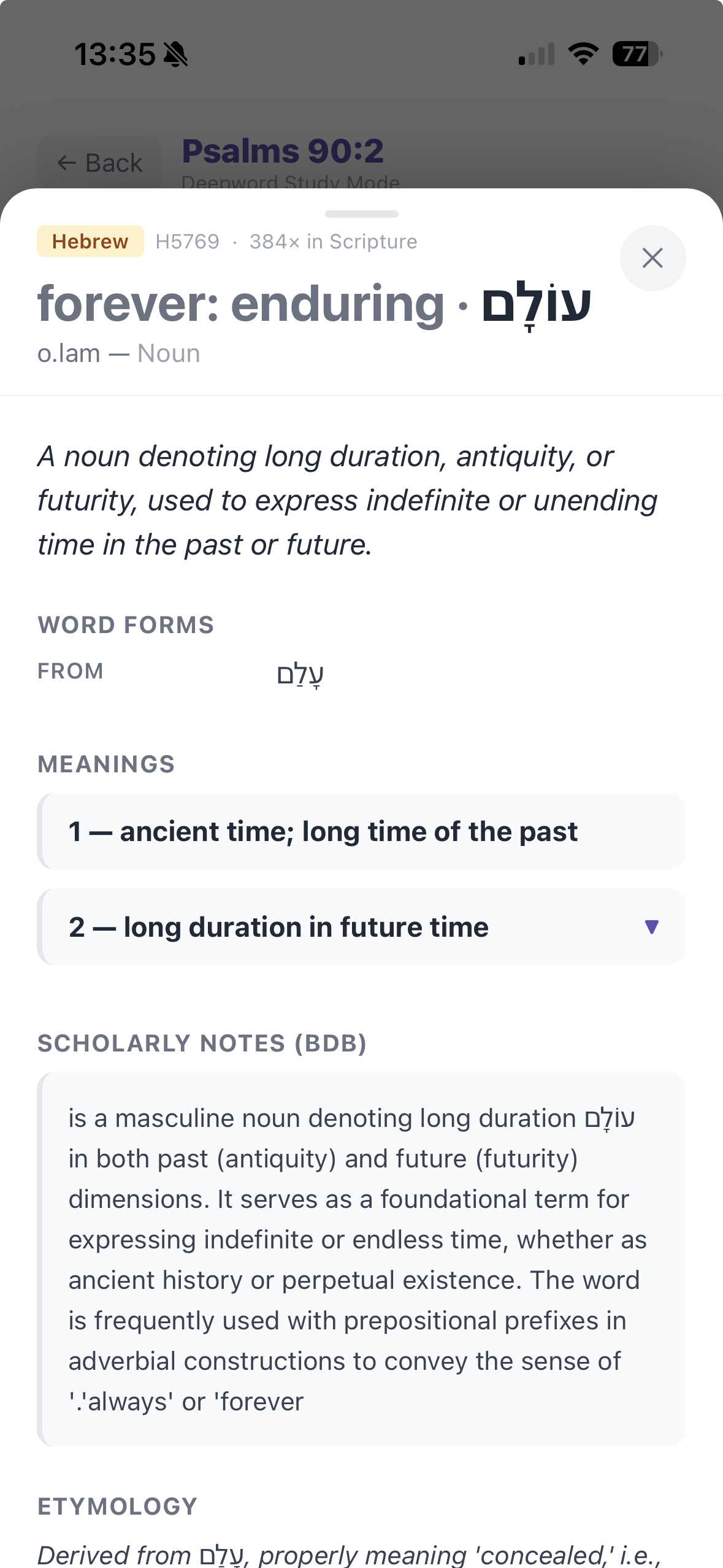
Open the full entry on olam in DeepWord and the two directions are right there, numbered, as the word's two basic senses.
Sense one is ancient time, long time of the past — antiquity. Sense two is long duration in future time, and it fans out into three: for ever, always; continuous existence, perpetual; and everlasting, indefinite or unending future, eternity.
Most English readers have only ever met sense two. Sense one is invisible in translation, because when a translator meets olam pointing backwards they don't write "everlasting" — they write "ancient," or "of old," and you never learn it was the same word.
Follow it around and the horizon keeps moving.
Four hundred and thirty-eight occurrences, and the King James renders this single noun as for ever, ever, everlasting, evermore, perpetual, continuance, lasting, never, always, eternal — and also as old, of old, old time, ancient, long, and world.
Start with the pair from the top of this page, because it's the cleanest proof there is. Deuteronomy 32:7 opens "Remember the days of old" — in Hebrew, yemot olam, "days of olam." Micah 5:2 ends "from of old, from everlasting" — and that second phrase is mimei olam, "from the days of olam." Same two nouns, same construction. One became the days of old. The other became from everlasting.
Jeremiah 6:16 has it looking back too: "ask for the old paths, where is the good way." Olam paths — roads worn in past the edge of memory.
And then there are the verses where "for ever" plainly, undeniably ends.
In Exodus 21:6, a bondservant who loves his master has his ear bored through with an awl at the doorpost, "and he shall serve him for ever." That's le'olam. Deuteronomy 15:17 says the same thing. It means for the rest of his life — as far as anyone in that room could see.
In 1 Samuel 1:22, Hannah says she will bring Samuel to the house of the Lord and he will "abide there for ever." Same word. She means: for good, as far as I can see from here.
And in Jonah 2:6, from inside the fish, Jonah says "the earth with her bars was about me for ever." Le'olam. Chapter one told us how long that was: three days and three nights.
Jonah is not exaggerating and he is not being sloppy. He is using the word exactly right. He could not see the far side of it. That is what the word means.
God put the horizon inside you.
Which brings us to the strangest sentence olam ever turns up in.
Ecclesiastes 3:11, in the King James: "He hath made every thing beautiful in his time: also he hath set the world in their heart, so that no man can find out the work that God maketh from the beginning to the end."
The world there is olam. And look what happens to that clause across the ten translations in DeepWord: the KJV, the Restored Name KJV and Darby say God set "the world" in the human heart. The ASV, the Berean Standard, the New Heart and the WEB say he set "eternity" there. The Lexham says he put "the past" there. Young's says "knowledge." The Bible in Basic English gives up on it entirely and says the opposite — that he made their hearts "without knowledge."
Nobody is being careless. They're guessing which end of the horizon the writer meant, because the word doesn't say. It only ever says: past where you can see.
Which is why the sentence is so exact. God set the vanishing point inside a creature with seventy years. That is precisely the ache Ecclesiastes spends twelve chapters on — the sense that there is more road on both sides of your life than you will ever be shown, and you cannot stop leaning towards it.
None of this makes God smaller. It's worth saying plainly, because it's the obvious worry: if olam can mean "as long as one man lives," does calling God the olam God shrink him? It doesn't — for the same reason that calling him the God who is "from everlasting to everlasting" doesn't shrink him. The word marks the limit of our sight, not the limit of his existence. Abraham names him El olam, "the everlasting God," at Beersheba (Genesis 21:33); Isaiah calls him that too, adding that he "fainteth not, neither is weary" (Isaiah 40:28). The horizon doesn't shorten God. God stretches the horizon.
And this is the one place in Scripture where the word gets used twice in a single breath, facing both ways at once — which is the only way to say the thing Moses wanted to say.
Back as far as anyone can see, and forward as far as anyone can see, and at both of those vanishing points, already standing there: thou art God.
Psalm 103:17 does the same trick with the word we looked at in an earlier study: "the mercy of the LORD is from everlasting to everlasting" — chesed, God's stubborn covenant loyalty, stretched from one horizon to the other. Not just how long he lasts. How long he keeps his word.
Moses was not saying God lasts a very long time. He was saying: everywhere your looking gives out — behind you, ahead of you — he is already there.