"In the beginning was the Word, and the Word was with God, and the Word was God." It's the grandest opening sentence in the Bible, and one of the most familiar — John 1:1, read every Christmas, quoted in every debate about who Jesus is. We hear "the Word" and picture, vaguely, something spoken. A message. A voice.
But the Greek word John chose carries far more weight than English "word" can hold. To a first-century reader, it named the single biggest idea in all of Greek thought — and John's whole point is hiding inside it.
The verse you can recite from memory.
"In the beginning was the Word, and the Word was with God, and the Word was God. The same was in the beginning with God. All things were made by him." We read "the Word" and our minds slide right past it — a capital-W title for Jesus, familiar enough that we stop asking what it actually means. Today, stop on it. Why that word? Why not "the Son," or "the Christ," or "the Voice"?
Every translation says "Word" — and every translation is straining.
Here the English Bibles are unusually united: KJV, NIV, ESV, every one of them says "the Word." But that agreement hides a problem rather than solving it. English "word" means a unit of speech — the thing between two spaces on a page. The Greek behind it means that and a great deal more, and translators have no single English term that holds all of it. So they pick the narrowest piece — "word" — and hope you'll feel the rest.
The word John actually wrote.
The Greek is λόγος — logos (Strong's G3056), from the verb legō, "to say." Yes, it means a spoken word. But by John's day logos had become the most loaded word a Greek could use. Heraclitus had used it five centuries earlier for the rational order running through all things. The Stoics built their whole worldview on it: the logos was the divine reason pervading the universe, the logic that holds the cosmos together and makes it make sense. It's the root we still carry in "logic," and in every -ology — bio-logy, theo-logy, the reasoned account of a thing.
Its plain meaning: not just speech, but the reason behind everything.
So logos sits on top of two huge ideas at once. To the Greek reader it meant reason — the rational principle that orders and sustains reality. To the Hebrew reader it echoed something just as deep: "And God said, Let there be light" (Genesis 1), and "By the word of the LORD the heavens were made" (Psalm 33:6) — the creative speech that called the world into being. John reaches for the one word that rings both bells.
And the lexicon shows the whole range.
Open the full lexicon entry on logos in DeepWord and you see the span the English flattens. The standard Greek lexicon (Thayer's) defines it as "a word or saying embodying a conception" — not just a sound, but a thought made expressible — running all the way through speech, discourse, and doctrine to, in its own words, "(in John's Gospel) the Divine Word." It traces the deeper sense too: logos as that by which inward thought is expressed — reason itself, given a voice. The whole arc, from an ordinary spoken word up to the mind of God, sits in one entry.
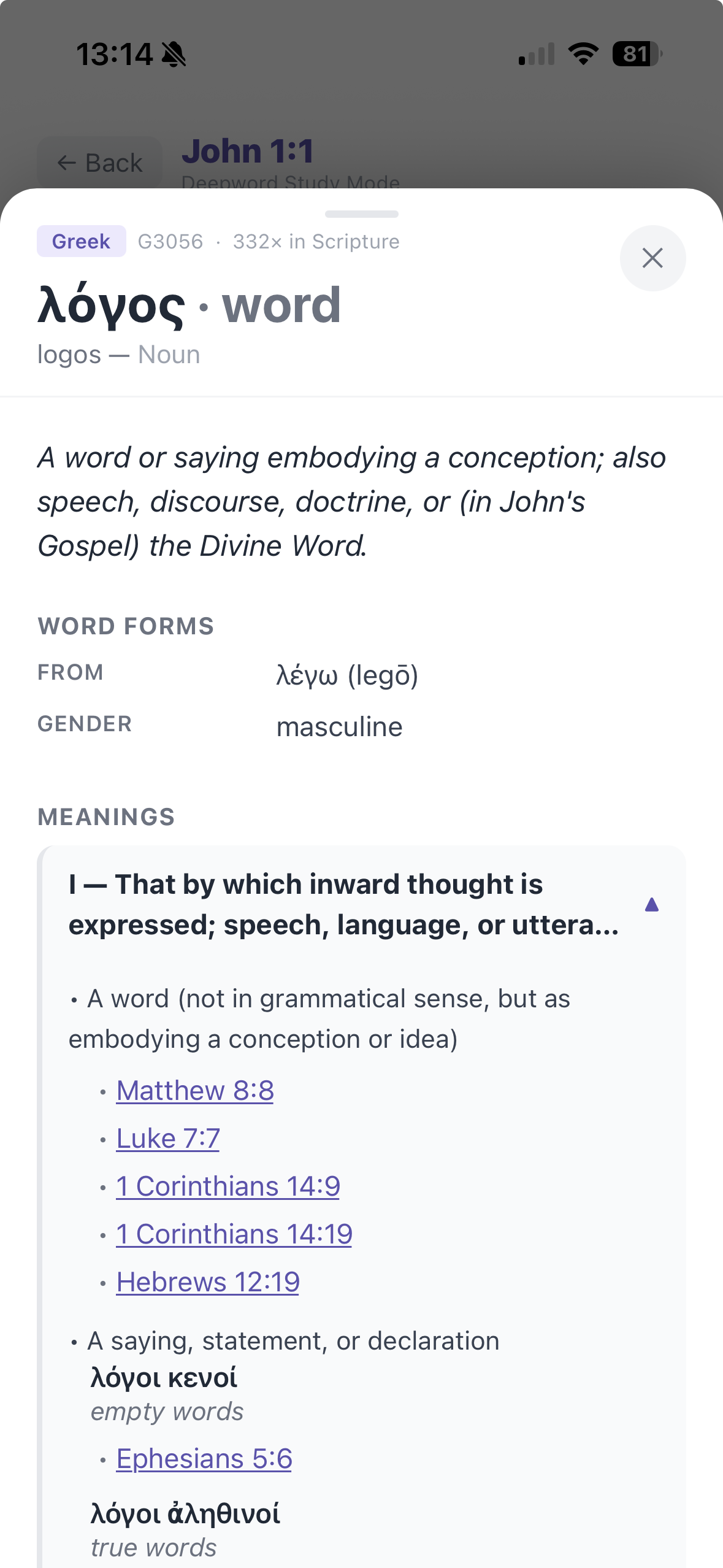
See it everywhere else it appears.
Once you know logos, you find it threaded through the whole New Testament — it appears more than 330 times. It's the "word" of God that "is living and active" (Hebrews 4:12). It's the gospel "message" the apostles preached. It's the "account" each of us will one day give. Most of the time it's translated, plainly, "word" — but John 1 is where the term reaches its full height: the reason behind the universe, named and personal.
The picture John actually painted.
So John 1:1 isn't a poetic flourish about something God said. It's the boldest claim in the New Testament. To the Greek who believed an impersonal logos ordered the cosmos, John says: that ordering reason isn't a force — it's a person, and "the Word was made flesh, and dwelt among us." To the Hebrew who knew God spoke the world into being, John says: that creative Word was there "in the beginning," and "all things were made by him." (If you've read our study of agape in 1 John 4:8, this is the same John, doing the same thing — taking one ordinary-looking word and showing you the universe inside it.)
You've read "In the beginning was the Word" your whole life. It took one Greek word to show that John wasn't describing a message. He was telling you that the logic behind everything that exists has a name, and a face.