"Fellowship" has become one of the gentlest words in church English. It means coffee after the service, name tags, a potluck in the basement, being friendly with people you'd otherwise never have met. Pleasant. Optional. Not the sort of thing anyone would sell a field over.
The Greek word underneath it in Acts 2:42 is a word about ownership.
The verse, in its setting.
"And they continued stedfastly in the apostles' doctrine and fellowship, and in breaking of bread, and in prayers" (Acts 2:42). This is Luke's snapshot of the church three thousand converts old, one sermon into its existence. Four things hold it together, and "fellowship" is listed alongside the apostles' teaching, the bread and the prayers — load-bearing company. Whatever it meant, it wasn't the social hour after the real thing.
Here the translations agree — and that's the tell.
At Acts 2:42, all ten translations in DeepWord land on the same English word: "fellowship" (the BBE alone rewords it as "united together"). No split, no argument. Which normally means there's nothing to see.
The split shows up somewhere stranger. Follow that same Greek word through the rest of the New Testament and watch what the King James does with it: it becomes "communion" at the Lord's table, "communication" in Philemon, "distribution" in 2 Corinthians 9 and "contribution" in Romans 15. Modern versions add "partnership," "participation" and "sharing." One Greek noun, seven English words — including two that plainly mean money.
The word Luke actually used.
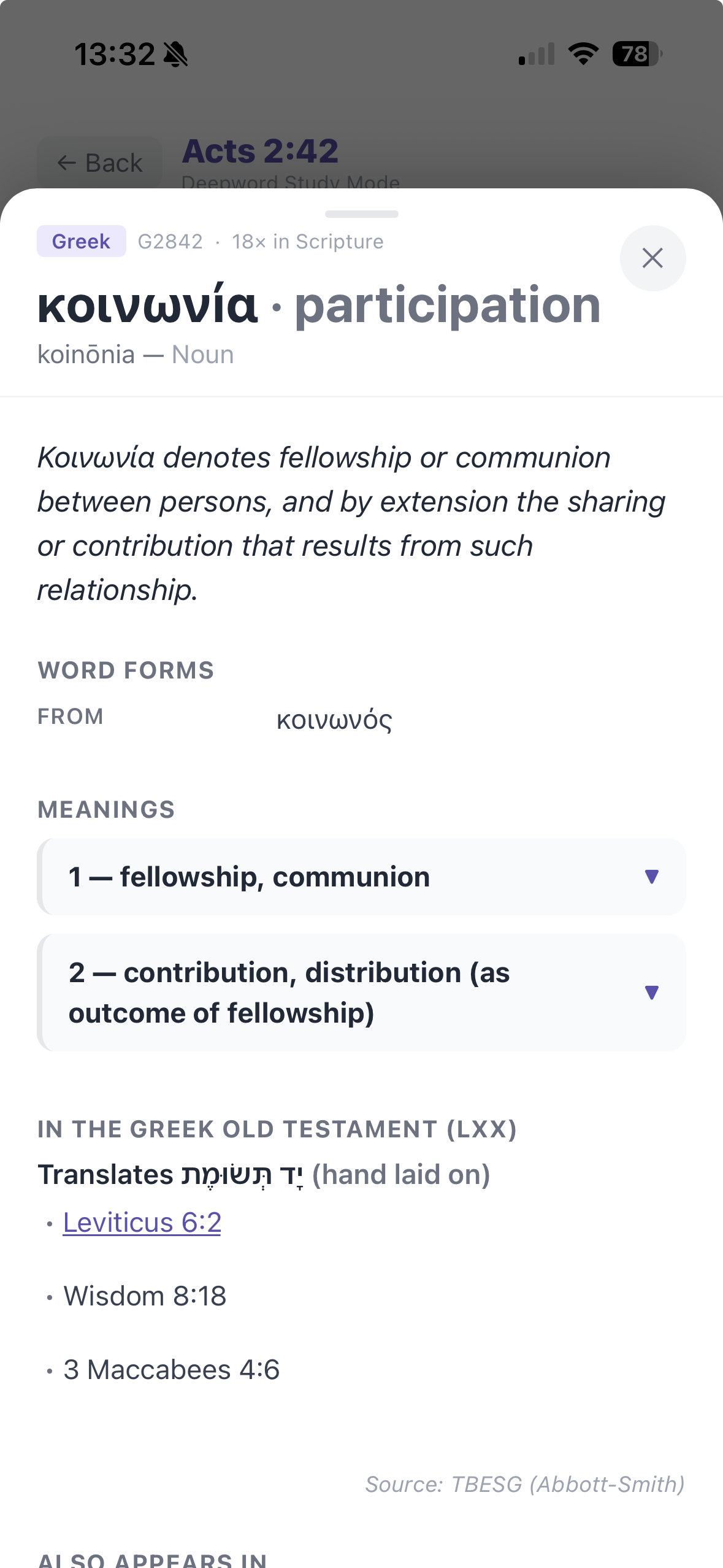
The Greek is κοινωνία — koinōnia (Strong's G2842), and it appears eighteen times in the New Testament. It's built on koinōnos (G2844), "a partner," which is built in turn on koinos (G2839), the everyday adjective for common — shared, held by more than one person. So koinōnia is, quite literally, commonness: the state of having something jointly.
Its plain meaning: a shared stake, not a shared mood.
The parent word tells you the register it comes from. In Luke 5:10, James and John are described as Simon Peter's koinōnoi — the King James says "partners," and it means exactly that: three men with a stake in the same fishing business, sharing the boats, the nets, the risk and the catch. Paul uses the same word of himself in Philemon 17: "if thou count me therefore a partner."
That's the ordinary weight of the family. Not an emotion, and not proximity. A koinōnos is someone whose outcome is tied to yours because you're both invested in the same thing. Koinōnia is the arrangement itself.
And the lexicon lays it out plainly.
Open the full entry on koinōnia in DeepWord and the two halves sit right next to each other. First: fellowship, communion — used with a genitive naming what's held in common, "of the Son," "of the Spirit," "of his sufferings." Then, without a break: contribution, distribution, filed as the outcome of that fellowship. The lexicon doesn't split these into two words that happen to look alike. It's one word, and the money sense is simply what the first sense looks like when it reaches somebody's wallet.
Luke defines it himself, two verses later.
You don't have to reach for a lexicon to know what Luke meant by "fellowship," because he tells you almost immediately. Acts 2:44: "And all that believed were together, and had all things common." That word — koina — is the root of the word he used two verses earlier. He says koinōnia, and then he shows you: they sold their possessions and divided the proceeds "as every man had need" (v.45).
The rest of the New Testament keeps both directions of the word in play. Downward, into the ledger: the relief fund Macedonia and Achaia raised for the starving believers in Jerusalem is called a koinōnia (Romans 15:26), and in 2 Corinthians 8:4 those same churches begged Paul for "the fellowship of the ministering to the saints" — they pleaded for the privilege of paying. Upward, into God: we were "called unto the fellowship of his Son" (1 Corinthians 1:9), the cup is "the communion of the blood of Christ" (1 Corinthians 10:16), Paul wants to know "the fellowship of his sufferings" (Philippians 3:10), and John writes so that "our fellowship is with the Father, and with his Son" (1 John 1:3). When James, Peter and John accept Paul's mission, they give him "the right hands of fellowship" (Galatians 2:9) — a handshake closing a partnership.
It's also the word in the verse just before the one we looked at in the study on kenoō: "if any fellowship of the Spirit" (Philippians 2:1), the ground Paul stands on before asking that church to pour itself out the way Christ did.
What the King James was reaching for.
Here's the quiet joke: "fellowship" was once the perfect translation. The English word comes from an old Norse term for a fee-layer — someone who lays down money alongside someone else in a joint venture. A "fellow" wasn't originally a nice chap you knew. He was your business partner, the man whose property was in the pot with yours. The 1611 translators picked a word that carried the same commercial weight as the Greek.
Four centuries of dinners and socials later, the English word has been emptied of everything but the warmth, while the Greek still holds the whole thing: a common life, a common table, a common purse, a common Lord.
None of which settles how any particular church should organise its money — that's a conversation about many passages, not one noun. But it does change what Luke is describing at the birth of the church. Not three thousand people who enjoyed each other's company. Three thousand people who had gone in on something together.