"Made himself of no reputation" sounds like something a PR consultant would advise against. It reads like Christ managed his image downward — a quiet, dignified step back from the spotlight. Careful, controlled, a little abstract.
The Greek word underneath it isn't careful or abstract at all. It's a verb for tipping something over and pouring it out until nothing is left inside.
The verse, in its setting.
"Who, being in the form of God, thought it not robbery to be equal with God: But made himself of no reputation, and took upon him the form of a servant, and was made in the likeness of men" (Philippians 2:6-7). Paul isn't writing abstract theology here for its own sake — he's mid-sentence in a plea to a squabbling church: "let this mind be in you, which was also in Christ Jesus" (v.5). The picture of Christ that follows is the example he wants them to copy.
Here the translations split into two different pictures.
The KJV and its close relative the RNKJV say Christ "made himself of no reputation." Nearly everyone else — the ASV, BSB, Darby, LEB, NHEB, WEB, YLT — says he "emptied himself." The BBE goes further still: "made himself as nothing."
Those aren't small stylistic differences. "No reputation" is a word about status and how others see you. "Emptied" is a word about substance — about what was inside something, and now isn't. One is social. The other is physical. Only one of them is what Paul actually wrote.
The word Paul actually used.
The Greek is κενόω — kenoō (Strong's G2758), built on kenos, the ordinary word for "empty" (G2756). At its root, kenoō just means to empty, to make empty. Paul's exact phrase is heauton ekenōsen — "himself, he emptied." Not "he lowered his reputation." He emptied himself. It's a container word, not a status word.
Its plain meaning: poured out, not stripped away.
A word of caution worth stating plainly: this verse has never meant Christ stopped being God, or lost some piece of his divine nature — the passage still calls him "equal with God" in the line right before it. What he emptied out wasn't his identity. It was the outward glory, privilege, and status that belonged to that identity — the visible weight of being God, set down on purpose, so he could show up as "a servant," "in the likeness of men."
And notice the grammar: it's reflexive and active. Nobody emptied him. He emptied himself. Nothing was taken. Something was poured out, by his own hand.
And the lexicon lays it out plainly.
Open the full entry on kenoō in DeepWord and the shape of the word is right there: first the literal sense, to empty, make empty — the one sense reserved for Philippians 2:7 alone — then the metaphorical sense used everywhere else in the New Testament, to make void, render vain or of no effect. Same verb, two directions: things get emptied, and things get emptied out of. Christ is the only place in the whole New Testament where the verb points at a person instead of a claim.
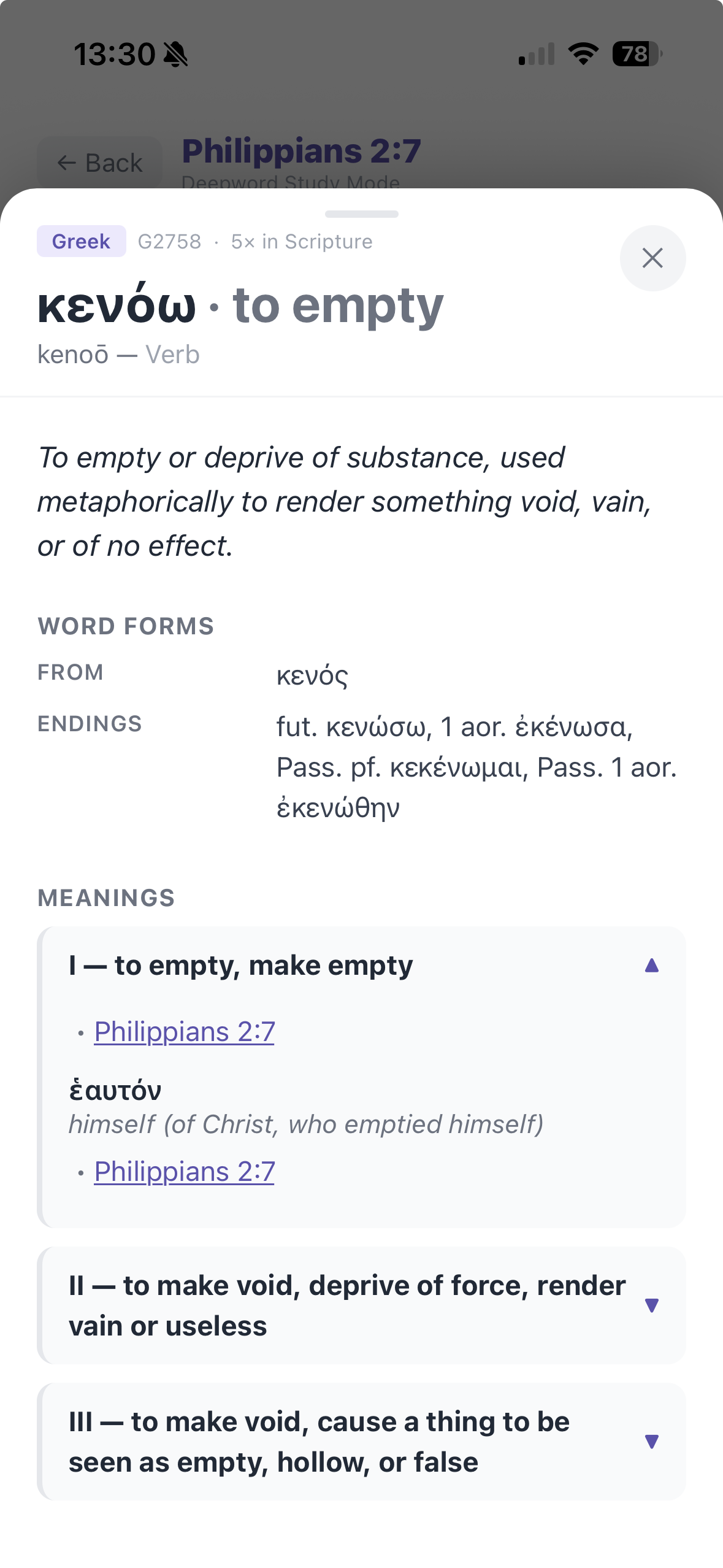
Every place it appears — and who Paul usually empties.
Kenoō is rare: it shows up only five times in the New Testament, and Paul wrote every one. Look at what gets emptied in the other four, and Philippians 2:7 stands out even more:
"If they which are of the law be heirs, faith is made void" (Romans 4:14) — a promise, drained of its force. "Lest the cross of Christ should be made of none effect" (1 Corinthians 1:17) — the message itself, hollowed out by clever words. "That I make not my glorying void" (1 Corinthians 9:15) and "our boasting... should be in vain" (2 Corinthians 9:3) — a boast, deflated to nothing.
Four times, kenoō is a verb of failure or threat: a claim that could collapse, a boast that could turn out hollow. Then Philippians 2:7 turns the same verb on a person — the one time it isn't a warning, and isn't done to something by accident. Christ takes the very verb for "drained of substance, come to nothing" and applies it to himself, deliberately, as the opening move of the incarnation.
What the King James was reaching for.
"Made himself of no reputation" isn't simply a mistranslation — in 1611, "reputation" carried an older, weightier sense: standing, rank, one's reckoning in the eyes of others, closer to "status" than to modern self-image. The King James translators were groping toward something real: Christ voided his own rank.
But four centuries later, "reputation" has drifted even further from that — now it mostly means what people happen to think of you, which isn't Paul's point at all. The blunter, older Greek image survives better: a jar, tipped, poured out on purpose until nothing remains inside. That's the "mind" Paul asks the Philippians to have in the two verses just before this one — not careful modesty, but a willingness to pour yourself out for someone else the way Christ poured out everything he had.