Psalm 23 ends gently in English. "Surely goodness and mercy shall follow me all the days of my life." You picture two kind companions strolling a few steps behind you, all the way home.
I've read that verse a hundred times and never stopped on it. Then one day I tapped the word follow — and found out the picture is far more aggressive than the English lets on.
The verse you think you already know.
"Surely goodness and mercy shall follow me all the days of my life, and I will dwell in the house of the Lord forever." It's the verse on the funeral card, the one stitched on the pillow. Comforting, familiar, easy to read past. Today, stop on the word follow.
The translators quietly disagree.
Read a few translations side by side and you notice a flicker of hesitation. Most say "follow." But the older notes and margins reach for something stronger — "pursue." That gap between follow and pursue is the whole story. One is passive. The other is on the hunt.
The word David actually wrote.
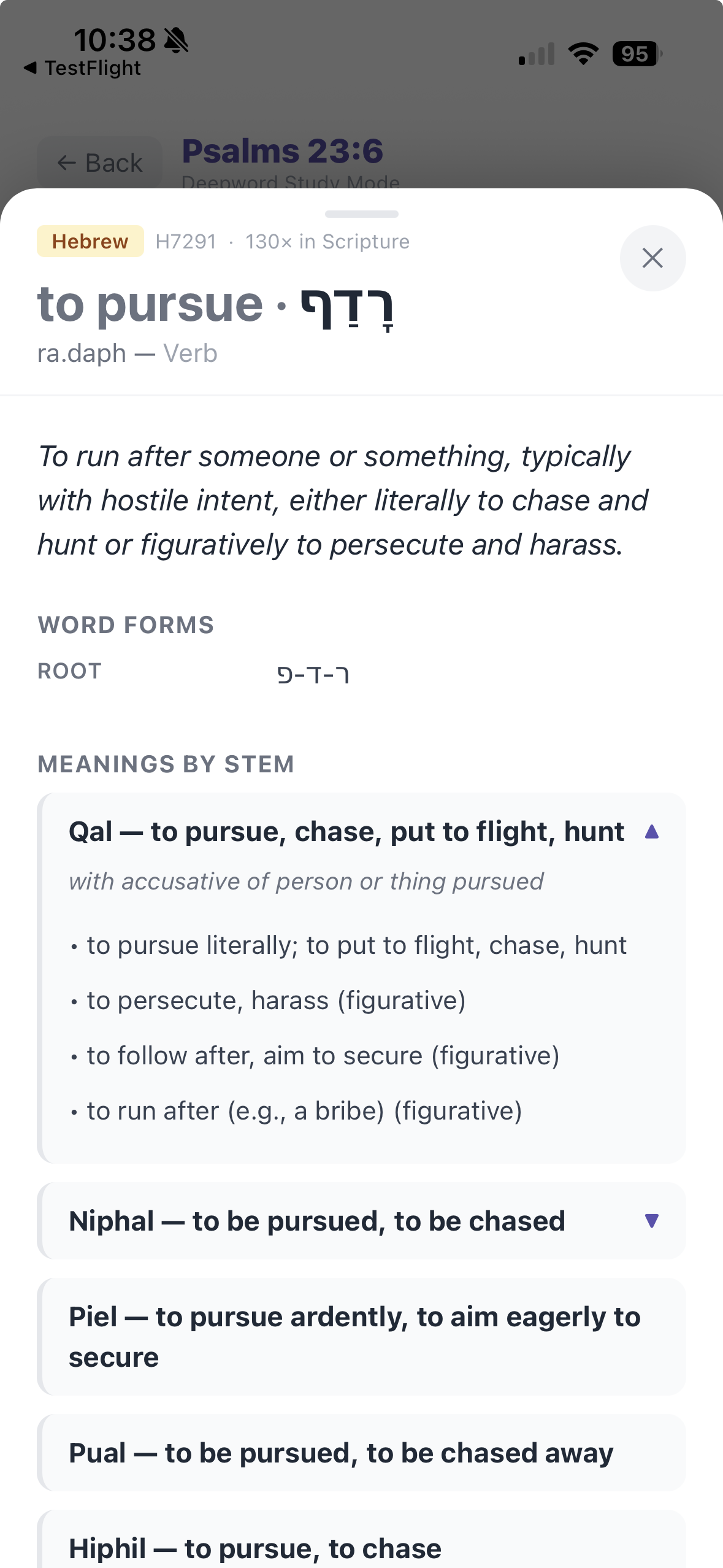
The Hebrew is רָדַף — radaph (Strong's H7291). And radaph is not a gentle word. It's the verb the Hebrew Bible uses for an army chasing a beaten enemy across a battlefield. For a hunter running down prey. For Pharaoh's chariots thundering after Israel toward the sea.
Its plain meaning: to chase, to hunt down.
Strip it to the core and radaph means to pursue, to chase, to hound — usually with hostile intent, the way a pursuer closes the distance on someone who's fleeing. David didn't write that goodness politely tags along behind him. He wrote that it comes after him — relentless, closing in, every day of his life.
And the lexicon confirms the twist.
Here's where it gets beautiful. Open the full lexicon entry on radaph in DeepWord and you find this: the standard Hebrew lexicon (Brown-Driver-Briggs) lists nearly every use of the word as hostile — blood pursuing a killer, enemies pursuing the weak. Then, buried in the entry, it flags one startling exception. In Psalm 23:6, the lexicon says, the very same verb is used "in a good sense, to attend closely upon."
That's the reversal. David takes the language of being hunted by an enemy and turns it inside out. The predator-and-prey dynamic is flipped: now it's God's goodness and steadfast love doing the chasing — and you're the one being run down.
See it everywhere else it appears.
Once you know the word, you can't unsee it. Radaph is Abram pursuing kidnappers to rescue Lot. It's the avenger of blood pursuing the manslayer. It's the curse in Deuteronomy that "pursues and overtakes." Around 140 times in the Hebrew Bible, this word means someone is being chased — usually toward disaster. Psalm 23:6 stands almost alone in pointing that energy the other way.
The picture David actually painted.
So the real image of Psalm 23:6 isn't a peaceful escort walking behind you. It's the most determined love in the universe in full pursuit of you — refusing to quit the chase, all the days of your life. And the word translated "mercy"? That's חֶסֶד, chesed — God's stubborn, covenant-keeping love, the one Hebrew word English never quite captures. (That one deserves its own study.)
You've read this verse your whole life. It took one word, in the original, to turn a quiet comfort into something that runs after you.