English quietly splits knowing in two. There's the knowing you do with your head — I know the capital of France, I know that water boils at 100°C. And there's the knowing you do with your life — I know my wife, I know that street, I know what grief feels like. Same word, two entirely different things. Other languages keep them apart: French has savoir and connaître. Spanish has saber and conocer.
Biblical Hebrew has one word. And it lands, hard, on the second kind.
The verse you think you already know.
"And Adam knew Eve his wife; and she conceived, and bare Cain." Genesis 4:1. Most of us learned early that knew here is the Bible being polite — a quaint old euphemism, the King James clearing its throat. We file it away as the shy way of saying something else and move on.
But the Hebrew isn't being shy. It's using its ordinary, everyday word for knowing. That's the part worth stopping on.
The translators quietly disagree.
Line up the translations on this verse and you can watch them split down the middle. The KJV, the ASV, Darby, Young's, the World English Bible all keep "the man knew Eve his wife." But the Berean Standard says "Adam had relations with his wife Eve." The Bible in Basic English says he "had connection with" her.
Both camps are trying to be faithful, and both give something up. "Knew" preserves the Hebrew word but sounds coy to a modern ear. "Had relations with" tells you what happened but throws the Hebrew word away. Neither one can do what the Hebrew does effortlessly — say knowing, and mean all of it at once.
The word Moses actually wrote.
The Hebrew is יָדַע — yada (Strong's H3045). It's a verb, and it's everywhere: more than 800 times across the Hebrew Bible, one of the busiest words in Scripture. The King James alone renders it "know" 645 times, and then reaches for a small crowd of other English words when "know" won't stretch — perceive, discern, acknowledge, consider, be acquainted with, be skilful in, understand, tell, teach.
That list is the whole story in miniature. English needs nine words. Hebrew uses one.
Its plain meaning: to know — by encounter.
The senses of yada all share a spine: knowledge that comes from contact. To learn to know. To perceive. To see and find out and discern. To know by experience. To recognize, admit, acknowledge. To be acquainted with a person. To know how to do a thing — to be skilful in it, which is knowing so deep it lives in your hands.
Nowhere in that range is the knowing of a spectator. There's no sense of yada that means "I read about it." Which is why the same verb covers the most intimate thing two people can do. It isn't that Hebrew borrowed a polite word for sex. It's that Hebrew's word for knowing already meant the kind of knowing that costs you your distance — and marriage is simply the far end of that scale.
And the lexicon confirms the twist.
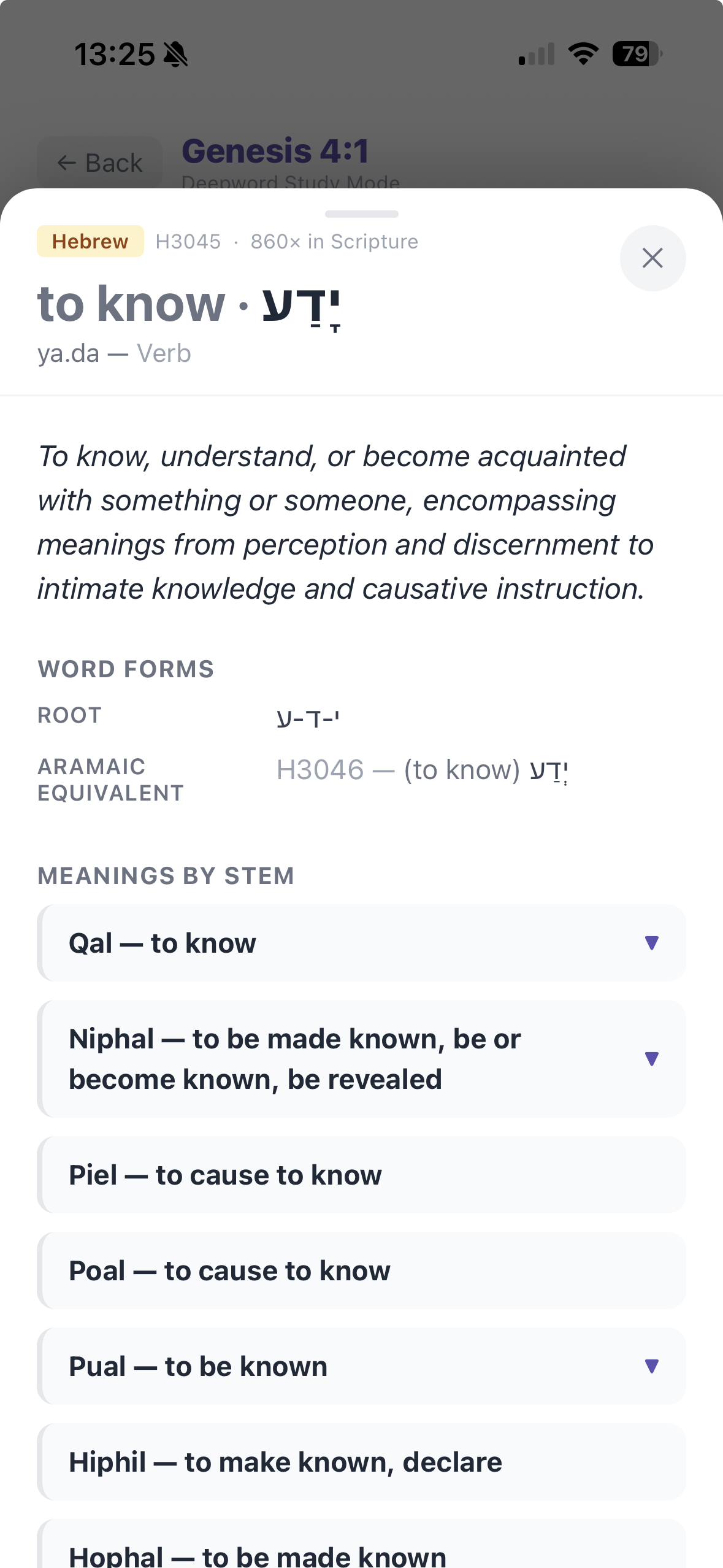
Open the full lexicon entry on yada in DeepWord and the range is laid out in plain sections — know, learn to know, perceive, find out and discern, discriminate, know by experience, recognize and acknowledge and confess, be acquainted with a person, know how, be skilful in. Sense after sense, and every one of them involves stepping close.
See it everywhere else it appears.
Once you know the word, it starts turning up in places you'd never have connected to Genesis 4.
"The Lord knoweth the way of the righteous" (Psalm 1:6). Not: God has your file. God walks your road.
"You only have I known of all the families of the earth" (Amos 3:2). God had certainly heard of the other nations. Yada is not information — it's the language of being chosen and entered into.
And then the one that stops you: "Before I formed thee in the belly I knew thee" (Jeremiah 1:5). Same verb. Before there was a single fact about Jeremiah to know, God yada'd him. Not knowledge about a person who didn't exist yet — knowledge of him.
There's one more thread. The noun built on this root is da'ath (H1847), and it's the word sitting in the middle of the sentence that changed everything: the tree of the knowledge of good and evil (Genesis 2:17). Not the tree of information. The tree of knowing-by-tasting. Which is exactly what went wrong.
The picture Moses actually painted.
So Genesis 4:1 isn't the Bible blushing. It's the Bible using its real word for knowing, in the place where human knowing goes deepest, because in Hebrew that's what the word has always meant. Knowing is never neutral, never remote, never free. It asks for your presence.
Which reframes what God is after. Scripture almost never asks you to know about him. It asks you to yada him — and, more startling, it says he already yadas you, from before the womb. That was always the word. English just couldn't carry it across.