The Bible is one verse old when it happens. "And the Spirit of God moved upon the face of the waters." Capital S, Spirit — settled, theological, familiar.
But the Hebrew word under "Spirit" is one English can't hold in a single word. I tapped it expecting a definition. What I got was three — and a translation argument running right through the second verse of the Bible.
The verse you think you already know.
"And the earth was without form, and void; and darkness was upon the face of the deep. And the Spirit of God moved upon the face of the waters." Darkness, deep water, and God's Spirit just above the surface. It's one of the most majestic sentences ever written. Today, stop on the word Spirit.
The translators quietly disagree.
Line up a few translations and verse two starts to wobble. Most say "the Spirit of God." But some respected translations print "a wind from God swept over the face of the waters" — and others put that reading in a footnote, unable to fully let it go. Spirit or wind? That's not a small difference. And the verb wobbles too: the old translations say the Spirit "moved"; modern ones say it "hovered." Something in the Hebrew is refusing to sit still in English.
The word Moses actually wrote.
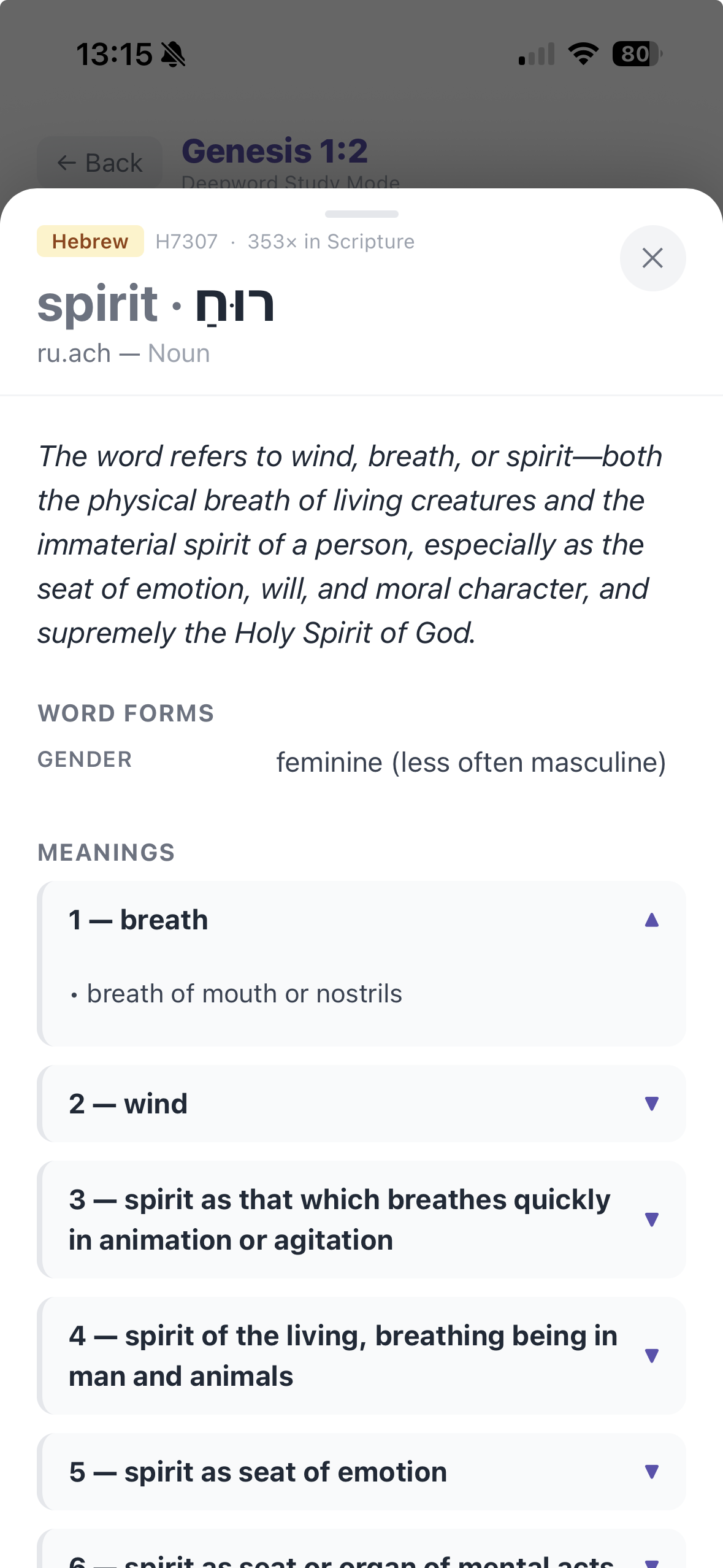
The Hebrew is רוּחַ — ruach (Strong's H7307). It appears 378 times in the Hebrew Bible, and it doesn't mean "spirit" or "wind" or "breath." It means all three — at once. The same word is the storm that parts the sea, the air in your lungs, and the Spirit of God himself.
Its plain meaning: breath, wind, spirit.
Strip it to the core and ruach is moving air that carries life — felt, never seen. English forces a translator to pick one lane every single time the word appears. Hebrew never picks. When Moses wrote ruach Elohim over the dark waters, a Hebrew reader heard wind and breath and Spirit in one breath of a word — God's own life, stirring over the deep before anything exists.
And the lexicon confirms it.
Open the full lexicon entry on ruach in DeepWord and you can watch the scholars sort all 378 occurrences into exactly those three piles: breath of mouth or nostrils, the very sign of being alive; wind, from the four winds of heaven to the evening breeze in Eden; and spirit — courage, temper, the seat of a person, and the Spirit of God. And where does the standard Hebrew lexicon (Brown-Driver-Briggs) file Genesis 1:2? Under the Spirit of God "as energy of life." Before there is light, before there is anything, the life of God is already breathing over the water.
There's one more gift hiding in the verse. The word for what the ruach is doing — merachepet, "hovering" — is used elsewhere of a mother bird fluttering over her young in the nest. That's the picture: not a force field over dead water, but a living presence brooding over creation the way an eagle broods over what's about to hatch.
See it everywhere else it appears.
Once you know the word, you can't unsee it. After the flood, God sends a ruach over the waters — your Bible says "wind," but it's the same word, the same scene, creation starting over. In Ezekiel's valley of dry bones, one prophecy uses ruach as breath, wind, and Spirit — "come from the four winds, O breath" — and English has to keep switching words while Hebrew just says ruach, ruach, ruach. And at the end of a life, Ecclesiastes says the ruach returns to God who gave it.
The picture Moses actually painted.
So the real image of Genesis 1:2 isn't an abstract divine presence floating over the sea. It's the breath of God — as real as wind on water — brooding like a mother bird over a world about to be born. And every breath you've taken since is the same word. The original language never separates God's Spirit from the air that keeps you alive; only our translations do.
You've read this verse your whole life. It took one word, in the original, to turn "the Spirit moved" into something you can feel in your own lungs.