Say "firmament" and you picture architecture. A dome. A ceiling of sky. Something vast and finished and empty — the roof over the world, spanning silently overhead with nothing much going on. It sounds like a place, a big blank space where the stars get hung later.
But the Hebrew word under "firmament" isn't an architecture word at all. It comes from the workshop. It's a word about hammering.
Day two, and God builds a sky.
"And God said, Let there be a firmament in the midst of the waters, and let it divide the waters from the waters." Genesis 1:6 — the second day of creation, right after light. Before there are stars, before there are seas, God makes this: the thing that holds the waters apart and gives the world a top.
It's one of the most repeated nouns in the whole creation account — nine times in Genesis 1 alone. Whatever this word is, Moses wanted it ringing in your ears. So it's worth asking what it actually says.
The translators can't agree what to call it.
Line up the English versions on this one verse and watch them scatter. The KJV and ASV keep the old word "firmament." The Berean, Darby, World English and New Heart English all say "expanse." The Lexham goes with "vaulted dome." And the Bible in Basic English reaches for "a solid arch stretching over the waters."
Firmament, expanse, vault, dome, arch. Five different pictures for one Hebrew word — and every one of them describes the finished shape of the sky. Not one of them tells you what the word is built from. That's the part English quietly drops.
The word Moses actually wrote.
The Hebrew is רָקִיעַ — raqia (Strong's H7549). And it's a noun grown straight out of a verb: raqa (H7554). Strong's defines that root as "to pound the earth; by analogy to expand by hammering; by implication, to overlay with thin sheets of metal — beat, make broad, spread abroad, stamp, stretch."
To beat. To hammer thin. To spread out by pounding. To overlay with metal. That's the verb hiding inside "firmament." So raqia doesn't mean "empty space overhead" — it means the beaten-out thing. The hammered expanse. What a metalworker makes when he takes a lump of gold and pounds it into a sheet wide and thin enough to cover a wall.
Its plain meaning: a sky hammered thin.
Picture a goldsmith at his bench, tapping a nugget out into gleaming leaf, spreading it wider and wider under the hammer until it's stretched taut and shining. Now scale that up to the size of the heavens. That's the image inside raqia: not a void that happened to be there, but a surface deliberately worked — beaten out and stretched across the deep by someone doing the beating.
English gives you the architecture — the dome, the vault, the arch. Hebrew gives you the craftsman and the hammer. The sky isn't a backdrop. It's a made thing.
And the lexicon lays it out.
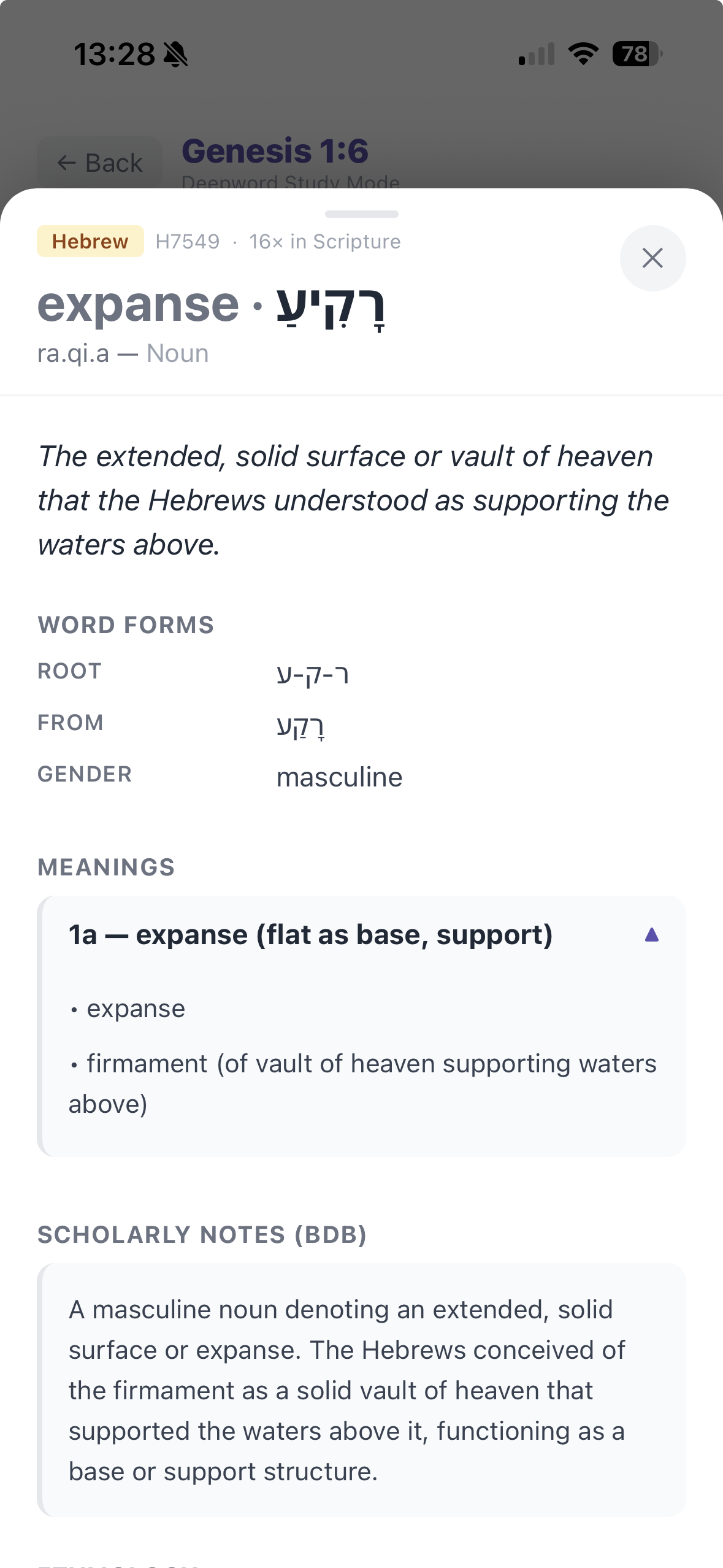
Open the entry behind "firmament" in DeepWord and the whole picture is there in plain sight — the root raqa, "to beat," the note that Hebrews pictured it "flat as a sheet of beaten metal," and the run of verses where the same word appears. It's the scholar's lexicon, restructured until a normal reader can actually follow the thread from the hammer to the heavens.
Watch the same hammer swing everywhere else.
Once you know raqa is a metalworker's verb, you start finding it at the forge all over the Old Testament. "They did beat the gold into thin plates" for the priest's garments (Exodus 39:3). The bronze censers were "made broad plates for a covering of the altar" (Numbers 16:39). "Silver spread into plates is brought from Tarshish… the work of the workman" (Jeremiah 10:9). Every time, the same root: metal, pounded flat and stretched wide.
And then the verse that says the quiet part out loud. Job 37:18 asks whether you could, like God, "spread out the sky, which is strong, and as a molten looking glass" — a cast-metal mirror, hard and gleaming. There it is in one line: the sky, made with the hammering verb, compared to a sheet of poured bronze. The heavens as the metalsmith's masterwork.
Why a hammered sky is good news.
Here's where it lands. "The heavens declare the glory of God; and the firmament sheweth his handywork" (Psalm 19:1). Read it in English and "handywork" is just a poetic flourish. Read it in Hebrew and it's exact: the raqia — the beaten-out sky — shows the work of his hands. The craftsman noun and the craftsman verse are saying the same thing on purpose.
So Genesis isn't describing a blank ceiling that drifted into place. It's describing something forged — hammered thin, stretched taut, worked by hands that meant every stroke. When you next stand under an open sky, the Hebrew wants you to see not empty distance but a finished piece of metalwork, still gleaming, still declaring the one who beat it out. English says firmament. Hebrew says look what he made.