In English, waiting is what happens when nothing is happening. A waiting room. Waiting on hold. Waiting for the light to change. It's dead time — the part of life you'd fast-forward through if you could. Passive by definition: the whole point of waiting is that there's nothing you can do.
So when Isaiah promises that "they that wait upon the LORD shall renew their strength," it sounds almost unfair. The people doing nothing get the eagle's wings? But the Hebrew word under "wait" isn't a doing-nothing word. It's a rope word.
The most beloved promise about waiting.
"But they that wait upon the LORD shall renew their strength; they shall mount up with wings as eagles; they shall run, and not be weary; and they shall walk, and not faint." Isaiah 40:31 — the close of a chapter written to an exhausted people in exile, a chapter that begins "Comfort ye, comfort ye my people."
Even the strong run out, Isaiah has just said: "even the youths shall faint and be weary, and the young men shall utterly fall." Then comes the reversal — and everything hangs on what "wait" means.
The translations split right down the middle.
Line up the English versions and you catch them disagreeing. The KJV, ASV, Berean, Darby, Lexham, World English: "wait." Young's Literal goes its own way with "those expecting Jehovah." And many modern versions outside that family — the NIV among them — abandon "wait" entirely and say "those who hope in the LORD."
Wait and hope are not the same word in English. One is a posture of the body, the other of the heart. When translators can't agree whether a word means waiting or hoping, that's your signal: the Hebrew word is both at once, and English forces a choice.
The word Isaiah actually wrote.
The Hebrew is קָוָה — qavah (Strong's H6960). And the dictionary entry starts somewhere you don't expect. Strong's gives the root sense as "to bind together, perhaps by twisting" — and only from there, "figuratively, to expect." The oldest scholarly guess behind this word is a picture: strands being twisted together into a cord.
You can see the picture still working elsewhere. In Genesis 1:9 — "let the waters under the heaven be gathered together unto one place" — the verb is qavah again: many waters wound into one. And the noun built directly on it, tiqvah, can mean a literal cord. This is not a word about empty minutes. It's a word about strands under tension, bound into something stronger than any of them alone.
Its plain meaning: hope stretched taut.
So biblical waiting isn't the waiting room. Qavah is expectant, directional, tensed — hope with its whole weight leaning on the thing hoped for, like a rope pulled tight to its anchor. You don't qavah the bus. You qavah what you're bound to.
That's why the translators split between "wait" and "hope": the word is hope in the shape of waiting — staying stretched toward God, holding the tension, refusing to let the line go slack.
And the lexicon lays it out.
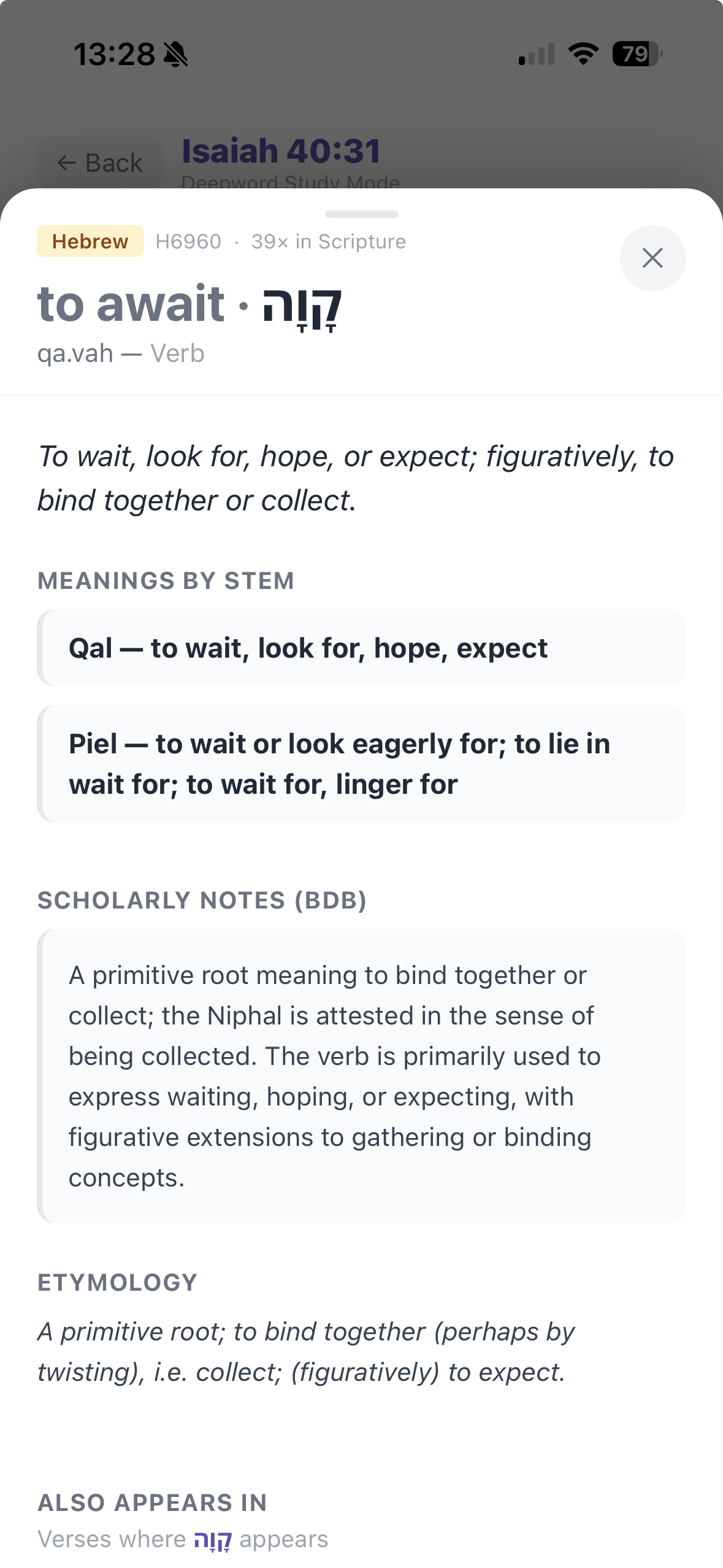
Open the entry behind "wait" in DeepWord and you can see the whole shape of it — the root sense of binding together, the stem-by-stem meanings ("to wait or look eagerly for," "to linger for"), and the company it keeps: verse after verse where the ones doing the waiting are waiting on the LORD. It's the scholar's lexicon, restructured until a normal reader can actually follow it.
See it everywhere else it appears.
Once you can hear the rope in qavah, the waiting verses stop sounding passive. "Wait on the LORD: be of good courage, and he shall strengthen thine heart: wait, I say, on the LORD" (Psalm 27:14) — twice in one verse, and it sits next to courage, not next to patience. "I wait for the LORD, my soul doth wait, and in his word do I hope" (Psalm 130:5) — a watchman stretched toward morning. "The LORD is good unto them that wait for him, to the soul that seeketh him" (Lamentations 3:25) — waiting and seeking in the same breath, active verbs both.
And the noun tiqvah hides the loveliest detail in the family. In Joshua 2:18, Rahab is told to bind "this line of scarlet thread" in her window — the word for that cord is tiqvah. Everywhere else in the Old Testament, tiqvah means hope. Same word. Her hope hung in the window, and it was a literal rope.
Why the waiting ones get the wings.
One more buried word seals it. "They shall renew their strength" — the Hebrew verb is chalaph, and elsewhere it means to change or exchange, the way you change clothes: "as a vesture shalt thou change them" (Psalm 102:26). The waiting ones don't recharge their own strength. They swap it — theirs handed over, his handed back.
Now the promise reads the way Isaiah wrote it. The people who qavah aren't the ones doing nothing; they're the ones who stay bound to God like strands of one rope, holding the tension when everything says let go — and through that binding, an exchange happens that no amount of striving produces. English says they waited. Hebrew says they held on, wound tight, until his strength ran into theirs.