"Comforter" is a soft word. It sounds like a quilt, or a hand on the shoulder — someone who sits beside you when you're low and says the gentle thing. So that's who we picture the Holy Spirit to be, because that's the word the King James handed us in John 14.
But the Greek underneath it isn't a soft word at all. It's a word from a courtroom.
The promise, on the last night.
"And I will pray the Father, and he shall give you another Comforter, that he may abide with you for ever." John 14:16 — Jesus, hours before the cross, telling a room of frightened men what happens after he's gone. Not "you'll manage." Not "be brave." Someone is coming to take my place beside you.
Everything rides on who that someone is. And the English word we've inherited quietly points us the wrong way.
Here the translations can't agree.
On most verses the English versions line up. On this one word, they scatter. The KJV and its heirs say Comforter. The ESV and NIV say Helper. The NRSV and Christian Standard say Advocate. Others reach for Counselor, Companion, even Friend.
Six English words for one Greek word — and none of them is wrong. That's the tell. When the translators can't settle on a rendering, it's because the original is holding several things at once that English keeps in separate boxes. No single word in our language can carry all of it, so each translator picks a corner and lets the rest fall away.
The word John actually wrote.
The Greek is παράκλητος — parakletos (Strong's G3875). Pull it apart and it's plain: para, "alongside," and a form of kaleō, "to call." A parakletos is one called to your side — summoned to stand next to you.
And in the Greek world, that word had a specific home: the courtroom. Your parakletos was the person you called to your side when you were the one on trial — your defense counsel, your advocate, the one who stands up and speaks for you when you can't speak for yourself. Not a soother of feelings. A defender.
Its plain meaning: the one summoned to help.
So the Spirit Jesus promises isn't first of all a comforter in our modern sense. He's the one called to your side to help — to defend you, plead for you, stand with you, steady you. Active, not soft.
And don't miss the small word in front of it: "another Comforter." The Greek there is allos — another of the same kind. Jesus is saying the Helper who's coming is one just like me. Everything he had been to them — beside them, for them, on their side — the Spirit will now be. And permanently: "that he may abide with you for ever." Jesus was with them for three years. This one doesn't leave.
And the lexicon lays it out.
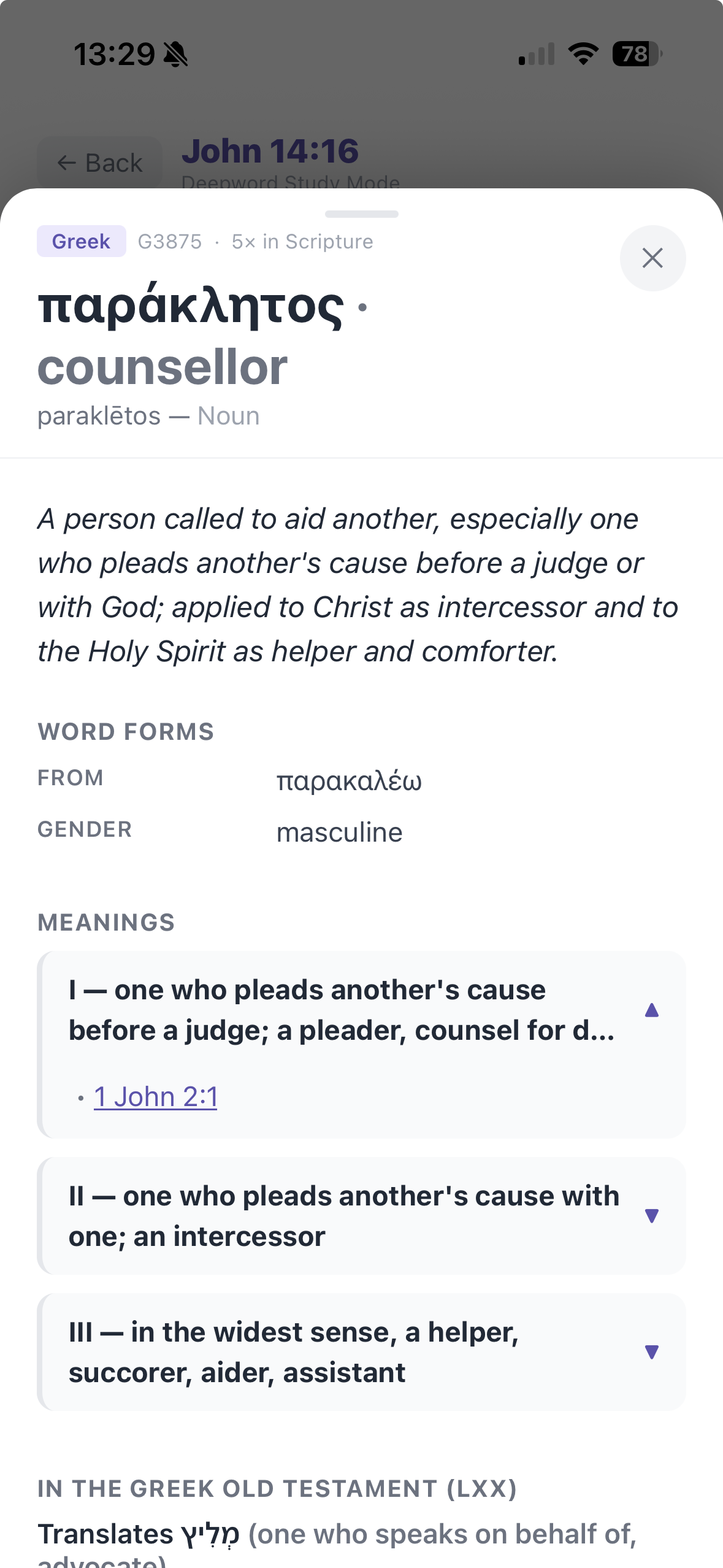
Open the full entry on parakletos in DeepWord and the senses stack up plainly — first one summoned, called to one's side, called to one's aid, then the legal advocate, counsel for the defense, then the widest sense, a helper. The verses sit beside each one. It's the scholar's lexicon, restructured until a normal reader can actually follow the shape of the word.
Every place it appears.
Parakletos is rare — it turns up only five times in the whole New Testament, and every one is worth seeing.
Four are in John, all of them the Spirit: John 14:16, 14:26, 15:26, 16:7. "The Comforter... shall teach you all things" (14:26). "He shall testify of me" (15:26) — courtroom language again, a witness taking the stand. This is a helper who defends, instructs, and gives evidence.
But the fifth is the one that opens the whole thing up. It isn't in a Gospel, and it isn't about the Spirit: "If any man sin, we have an advocate with the Father, Jesus Christ the righteous" (1 John 2:1). "Advocate" there is parakletos — the exact same word.
So Scripture hands you two of them, both in your corner: the Spirit called to your side down here, and Christ called to the Father's side up there, pleading your case at the throne. One beside you, one before God. Same word, both for you.
The mercy hiding in the old word.
And here's the quiet grace in "Comforter" after all. In 1611 it didn't mean what it means now. It came through the Latin confortare — com-, "wholly," and fortis, "strong." To comfort someone was to fortify them, to make them strong. The King James translators weren't picturing a quilt. They were picturing strength brought to your side.
Which is exactly what parakletos is. Not someone who pats your hand while you go under — someone called in to stand with you and hold you up. Two verses later Jesus says it straight: "I will not leave you comfortless: I will come to you" (John 14:18). The word there is orphanous — orphaned, abandoned. He is telling grown men afraid of being left alone: you will not be. Someone is coming to your side, of the same kind as me, to defend and strengthen you forever.
That's the difference one buried Greek word makes. English scatters it into six words because no single one can hold it. The original said it whole, all along — the one called alongside.