English has one word for time, and it does a lot of jobs. The time is 3 o'clock. I've known her a long time. This is the time. Same four letters for the clock on the wall and the moment that changes everything. We don't notice the flattening because we've never had anything to compare it to.
Greek had two words. And the first sentence Jesus preaches in Mark reaches for the one English can't see.
The opening line of the gospel.
"The time is fulfilled, and the kingdom of God is at hand: repent ye, and believe the gospel." Mark 1:15 — the very first words out of Jesus' mouth in the earliest Gospel. It reads like a starting gun. The time is fulfilled.
Which raises a quiet question we usually skip past: which time? The hour? The era? The countdown? In English there's no way to tell. In Greek there was never any doubt.
Every translation says the same flat thing.
Line up the English versions on this verse and, for once, they barely differ. The KJV, ASV, Berean, Darby, Lexham, World English — they all say "the time is fulfilled." A couple soften "fulfilled" to "has come," but the noun never moves. Everyone says time.
That agreement isn't a win. It's the problem. Every translator reached for the only English word available, and every one of them had to leave behind the thing the Greek makes obvious the instant you see it: which kind of time this is. English can't ask the question, so it can't answer it.
The word Mark actually wrote.
The Greek is καιρός — kairos (Strong's G2540). And Greek's other word for time is chronos (the root of chronology, chronometer, chronic) — time as it runs on a clock, seconds stacking into hours, the plain passage of duration.
Kairos is the other thing entirely. Not how much time, but which moment — the right one, the appointed one, the ripe one. They're so distinct that Greek can hold them side by side in a single breath: when the disciples ask about the end, Jesus tells them it's not theirs to know "the times [chronos] or the seasons [kairos]" (Acts 1:7). Two words, one sentence. English had to invent "times and seasons" just to keep up.
Its plain meaning: the appointed, ripe moment.
The lexicon roots kairos in an older, almost physical idea: due measure, fitness, the right proportion — the exact-rightness of a thing. From there it becomes time in the sense of a fixed and definite season, the opportune moment, the appointed occasion. It's the word for the season of fruit, the moment a harvest is ready to pick (Matthew 21:34). Not any time — the time, the one that's ripe.
Now hear the verb Mark pairs with it. "Fulfilled" is peplērōtai — filled full, brought to the brim. So the sentence isn't "the clock has run out." It's "the appointed moment has ripened — it's full." The one occasion all of history was waiting for has come to term, like fruit finally ready on the branch.
And the lexicon lays it out.
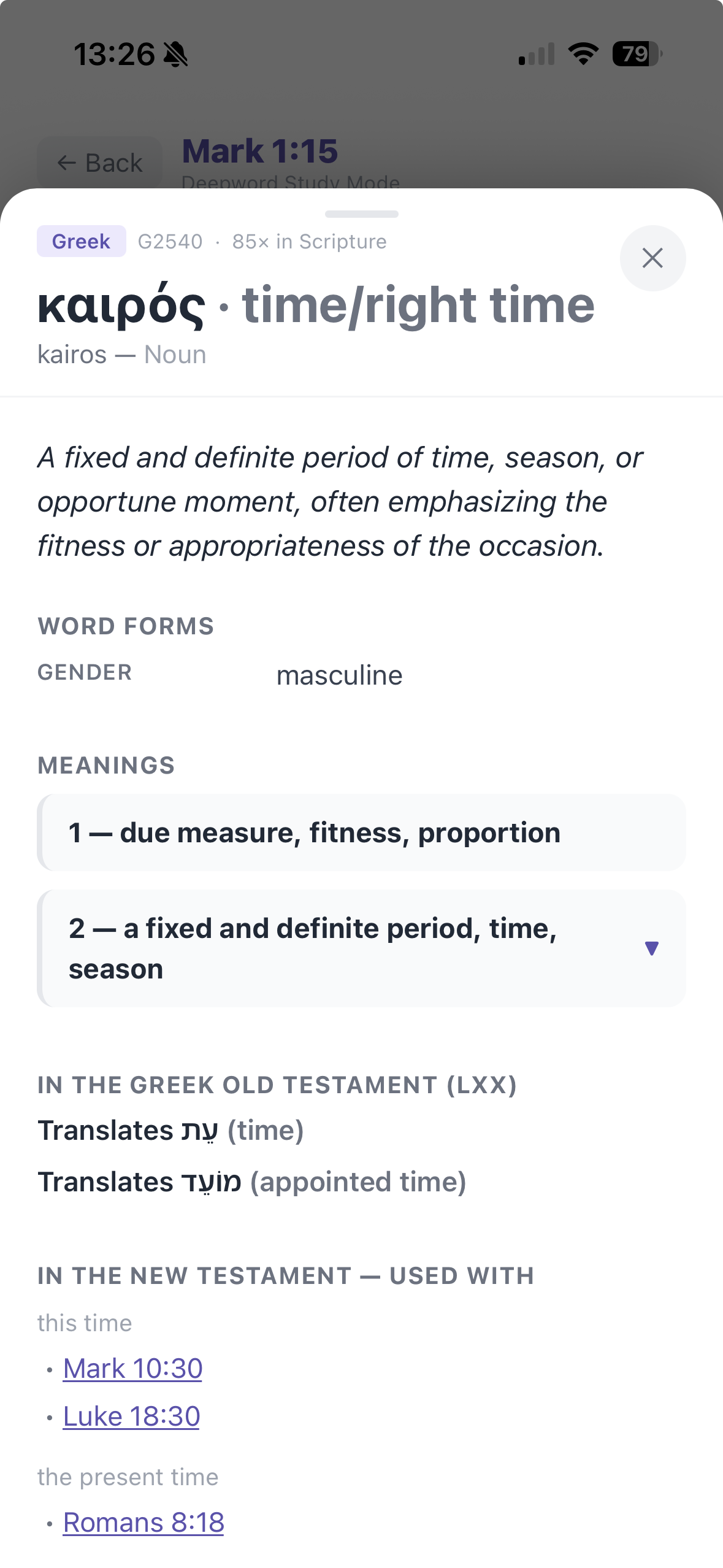
Open the full entry on kairos in DeepWord and you can see the two senses stacked plainly — first the old idea of due measure and fitness, then a fixed and definite period, a season, the opportune time — with the verses laid beside each one. It's the scholar's lexicon, restructured until a normal reader can actually follow it.
See it everywhere else it appears.
Once you can spot kairos, it keeps showing up exactly where the timing is the whole point.
"In due time Christ died for the ungodly" (Romans 5:6). Not eventually, not on schedule — at the moment, the appointed one.
"In due season we shall reap, if we faint not" (Galatians 6:9). The harvest word again — there's a ripe moment coming, so don't quit before it.
"Behold, now is the accepted time; behold, now is the day of salvation" (2 Corinthians 6:2). Both halves lean on kairos: the window is open now, this is the moment.
Even Paul's practical advice carries it: "redeeming the time" (Ephesians 5:16) is kairos — buy back the opportune moments, not just the hours. He isn't telling you to save minutes. He's telling you not to miss the openings.
The sentence Mark actually opened with.
So Jesus' first public words aren't a countdown running down. They're an announcement that the right moment — the one the prophets ached toward, the appointed season of God — has finally come full. Not "hurry, time's up." But "look — the moment is here, ripe, now."
That's the difference one buried Greek word makes. Chronos just passes. Kairos arrives. And the whole gospel opens on the second kind — the moment worth turning your whole life around for. English can only call it "the time." Greek told you which one all along.