When we say "here I am" in English, we're almost always reporting a location. Someone calls your name across a parking lot and you wave — here I am, over here, this is where I'm standing. It's a GPS pin. A hand raised at roll call. Useful, and completely flat.
So when Abraham says it at the hardest moment of his life, we read right past it. It sounds like he's just letting God know he's within earshot. He isn't. The Hebrew word underneath is doing something English can't even reach for.
The word that opens the hardest story in the Bible.
"And it came to pass after these things, that God did tempt Abraham, and said unto him, Abraham: and he said, Behold, here I am." Genesis 22:1 — the opening line of the Akedah, the binding of Isaac. In the next breath God will ask for his son.
Abraham doesn't yet know that. He only knows he's been called. And his answer comes back instantly, before a single condition, before he's heard the ask: here I am. In English that lands like an attendance check. In Hebrew it's the whole posture of the man.
Every translation flattens it the same way.
Line up the English versions and they barely move: "Here I am," "Here am I," "Behold, here I am." The KJV, ASV, Berean, Darby, Lexham, World English — all of them reach for the one phrase English keeps for this, the phrase we use to mark a spot in a room.
That agreement isn't the win it looks like. Every translator had the same problem: English owns a phrase for where I am and nothing clean for I'm all yours. So they used the locational one, and the readiness — the surrender that's actually in the word — quietly drained out.
The word Abraham actually said.
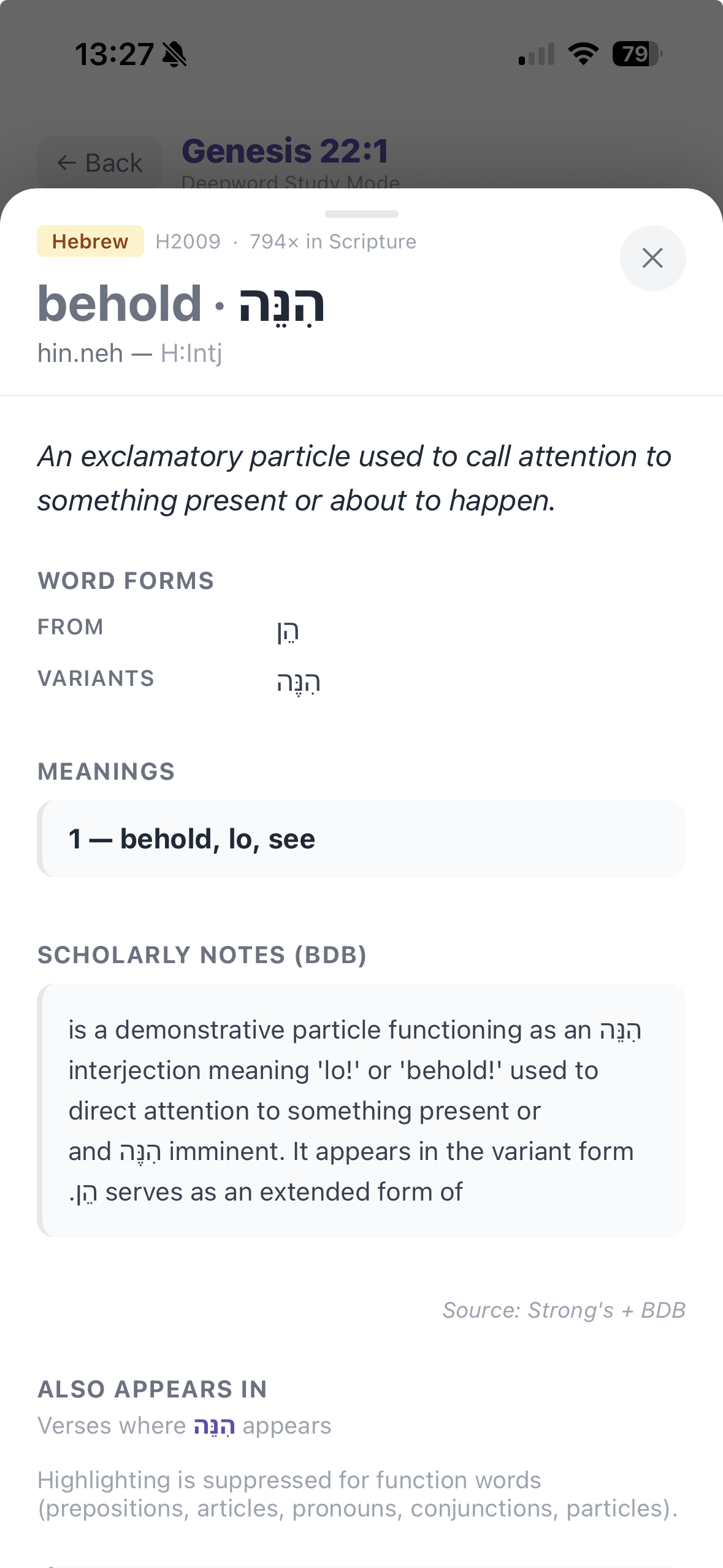
The Hebrew is הִנֵּנִי — hineni. And it isn't the word for "here." It's built from hinneh (Strong's H2009) — the attention-word, behold! look! see! — with the little suffix -ni, "me," fused onto the end.
So the literal shape of it isn't "here I am." It's closer to "Behold me." Not this is where I'm standing, but look — I'm right here, turned toward you, all of me. Hebrew even has a plainer word for physical here (poh). Abraham doesn't use it. He uses the word that points not to a place but to a person, fully present and facing you.
Its plain meaning: total availability, before the ask.
That's what makes hineni almost untranslatable in one line. It's not information about your coordinates — it's an offering of yourself. "Here I stand, awake, ready, yours — tell me what you need." A person saying hineni has already said yes before they've heard the question.
And that is exactly the weight of Genesis 22. Abraham says hineni in verse 1 — before God names Isaac, before he knows the road to Moriah is coming. The availability comes first. The terrible request comes second. The order is the whole point.
And the lexicon lays it out.
Open the entry behind hineni in DeepWord and you can see it plainly — hinneh, the demonstrative "behold, lo, see," the word that grabs a listener by the collar and says pay attention — with the "me" fixed to it, and the verses laid beside it. It's the scholar's lexicon, restructured until a normal reader can actually follow how the pieces fit.
See it everywhere else it appears.
Once you can hear hineni, you find it at every hinge point where someone is called and everything hangs on the answer.
God calls from the burning bush: "Moses, Moses. And he said, Here am I" (Exodus 3:4). The boy Samuel, woken in the dark, runs and says "Here am I" (1 Samuel 3:4). And Isaiah, undone in the throne room, hears "Whom shall I send?" and answers with the same word, now stretched to its full length: "Here am I; send me" (Isaiah 6:8). Every one of them is hineni — not a location, a surrender.
But the most staggering use is inside Genesis 22 itself. Abraham says hineni three times in one chapter. To God, in verse 1. Then to his son, when Isaac says "My father" and Abraham answers "Here am I, my son" (Genesis 22:7). Then to the angel who stops the knife: "Here am I" (Genesis 22:11).
The same total presence, given upward to God, downward to his child, and outward to the messenger — the same open, undefended behold me in all three directions, on the worst morning of his life.
The answer Abraham actually gave.
So the first word of the Akedah isn't a man confirming he's within shouting distance. It's a man handing himself over, whole, before he has any idea what it will cost. Behold me. I'm here, I'm awake, I'm yours — ask.
That's the difference one buried Hebrew word makes. "Here I am" points to a place. Hineni points to a person who has already said yes. English can only tell you where Abraham was standing. Hebrew tells you what he was doing with his whole life.